BANGABANDHU SHEIKH MUJIBUR RAHMAN
The life of Bangabandhu Sheikh Mujibur Rahman is the saga of a great leader turning peoplepower into an armed struggle that liberated a nation and created the world’s ninth most populous state. The birth of the sovereign state of Bangladesh in December 1971, after a heroic war of nine months against the Pakistani colonial rule, was the triumph of his faith in the destiny of his people. Sheikh Mujib, endearingly called Bangabandhu or friend of Bangladesh, rose from the people, molded their hopes and aspirations into a dream and staked his life in the long battle for making it real. He was a true democrat, and he employed in his struggle for securing justice and fairplay for the Bengalees only democratic and constitutional weapons until the last moment. It is no accident of history that in an age of military coup d’etat and ‘strong men’, Sheikh Mujib attained power through elections and mass movement and that in an age of decline of democracy he firmly established democracy in one of the least developed countries of Asia.
Sheikh Mujib was born on 17 March 1920 in a middle class family at Tungipara in Gopalganj district. Standing 5 feet 11 inches, he was taller than the average Bengalee. Nothing pleased him more than being close to the masses, knowing their joys and sorrows and being part of their travails and triumphs. He spoke their soft language but in articulating their sentiments his voice was powerful and resonant. He had not been educated abroad, nor did he learn the art of hiding feelings behind sophistry; yet he was loved as much by the urban educated as the common masses of the villages. He inspired the intelligentsia and the working class alike. He did not, however, climb to leadership overnight.
Early Political Life: His political life began as an humble worker while he was still a student. He was fortunate to come in early contact with such towering personalities as Hussain Shaheed Suhrawardy and A K Fazlul Huq, both charismatic Chief Ministers of undivided Bengal. Adolescent Mujib grew up under the gathering gloom of stormy politics as the aging British raj in India was falling apart and the Second World War was violently rocking the continents. He witnessed the ravages of the war and the stark realities of the great famine of 1943 in which about five million people lost their lives. The tragic plight of the people under colonial rule turned young Mujib into a rebel.
This was also the time when he saw the legendary revolutionary Netaji Subhas Chandra Bose challenging the British raj. Also about this time he came to know the works of Bernard Shaw, Karl Marx, Rabindranath Tagore and rebel poet Kazi Nazrul Islam. Soon after the partition of India in 1947 it was felt that the creation of Pakistan with its two wings separated by a physical distance of about 1,200 miles was a geographical monstrosity. The economic, political, cultural and linguistic characters of the two wings were also different. Keeping the two wings together under the forced bonds of a single state structure in the name of religious nationalism would merely result in a rigid political control and economic exploitation of the eastern wing by the all-powerful western wing which controlled the country’s capital and its economic and military might.
Early Movement: In 1948 a movement was initiated to make Bengali one of the state languages of Pakistan. This can be termed the first stirrings of the movement for an independent Bangladesh. The demand for cultural freedom gradually led to the demand for national independence. During that language movement Sheikh Mujib was arrested and sent to jail. During the blood-drenched language movement in 1952 he was again arrested and this time he provided inspiring leadership of the movement from inside the jail.
In 1954 Sheikh Mujib was elected a member of the then East Pakistan Assembly. He joined A K Fazlul Huq’s United Front government as the youngest minister. The ruling clique of Pakistan soon dissolved this government and Shiekh Mujib was once again thrown into prison. In 1955 he was elected a member of the Pakistan Constituent Assembly and was again made a minister when the Awami League formed the provincial government in 1956. Soon after General Ayub Khan staged a military coup in Pakistan in 1958, Sheikh Mujib was arrested once again and a number of cases were instituted against him. He was released after 14 months in prison but was re-arrested in February 1962. In fact, he spent the best part of his youth behind the prison bars.
Supreme Test: March 7, 1971 was a day of supreme test in his life. Nearly two million freedom loving people assembled at the Ramna Race Course Maidan, later renamed Suhrawardy Uddyan, on that day to hear their leader’s command for the battle for liberation. The Pakistani military junta was also waiting to trap him and to shoot down the people on the plea of suppressing a revolt against the state. Sheikh Mujib spoke in a thundering voice but in a masterly well-calculated restrained language. His historic declaration in the meeting was: “Our struggle this time is for freedom. Our struggle this time is for independence.” To deny the Pakistani military an excuse for a crackdown, he took care to put forward proposals for a solution of the crisis in a constitutional way and kept the door open for negotiations.
The crackdown, however, did come on March 25 when the junta arrested Sheikh Mujib for the last time and whisked him away to West Pakistan for confinement for the entire duration of the liberation war. In the name of suppressing a rebellion the Pakistani military let loose hell on the unarmed civilians throughout Bangladesh and perpetrated a genocide killing no less than three million men, women and children, raping women in hundreds of thousands and destroying property worth billions of taka. Before their ignominious defeat and surrender they, with the help of their local collaborators, killed a large number of intellectuals, university professors, writers, doctors, journalists, engineers and eminent persons of other professions. In pursuing a scorch-earth policy they virtually destroyed the whole of the country’s infrastructure. But they could not destroy the indomitable spirit of the freedom fighters nor could they silence the thundering voice of the leader. Tape recordings of Bangabandhu Sheikh Mujib’s 7th March speech kept on inspiring his followers throughout the war.
Return and Reconstruction: Forced by international pressure and the imperatives of its own domestic predicament, Pakistan was obliged to release Sheikh Mujib from its jail soon after the liberation of Bangladesh and on 10 January 1972 the great leader returned to his beloved land and his admiring nation.
But as he saw the plight of the country his heart bled and he knew that there would be no moment of rest for him. Almost the entire nation including about ten million people returning from their refuge in India had to be rehabilitated, the shattered economy needed to be put back on the rail, the infrastructure had to be rebuilt, millions had to be saved from starvation and law and order had to be restored. Simultaneously, a new constitution had to be framed, a new parliament had to be elected and democratic institutions had to be put in place. Any ordinary mortal would break down under the pressure of such formidable tasks that needed to be addressed on top priority basis. Although simple at heart, Sheikh Mujib was a man of cool nerves and of great strength of mind. Under his charismatic leadership the country soon began moving on to the road to progress and the people found their long-cherished hopes and aspirations being gradually realized.
Assassination: But at this critical juncture, his life was cut short by a group of anti-liberation reactionary forces who in a pre-dawn move on 15 August 1975 not only assassinated him but 23 of his family members and close associates. Even his 10 year old son Russel’s life was not spared by the assassins. The only survivors were his two daughters, Sheikh Hasina – now the country’s Prime Minister – and her younger sister Sheikh Rehana, who were then away on a visit to Germany. In killing the father of the Nation, the conspirators ended a most glorious chapter in the history of Bangladesh but they could not end the great leader’s finest legacy- the rejuvenated Bengali nation. In a fitting tribute to his revered memory, the present government has declared August 15 as the national mourning day. On this day every year the people would be paying homage to the memory of a man who became a legend in his won lifetime. Bangabandhu lives in the heart of his people. Bangladesh and Bangabandhu are one and inseparable. Bangladesh was Bangabandhu Sheikh Mujibur Rahman’s vision and he fought and died for it.
My practical experience, some of new leaders of BNP (retired amla) wants to be leader. They want to show something to Khaleda Zia in strike period. Want to be talk of the day as like Sadek Hossain Khoka. Khoka hold liquid tomato pack with him and blasted in due time while police caught him on the streets. Remember people? Shamsher Mobin Choudhury Beer Bikram Freedom fighter, I salute for his contribution, but I enjoyed his acting on strike period with police SI. He want to be arrested then news will be like this “Beer Bikram Shamsher Mobin Choudhury didn’t relief from the police tortured.
Good attitude but no need to do this simple acting for growing the attraction of Khaleda. Next time he will be foreign Minister if BNP comes to the power.
Bangabandhu Slideshow for website
http://picturepush.com/external.js.php?module=slide&mode=album&clid=28698&alid=87770&tagname=&q=&repeats=-1&time=2000
Published by Freedom Fighter Moktel Hossain Mukthi
http://shomoy71.blogspot.com/
http://august75tragedy.blogspot.com/
http://extremistinbangladesh.blogspot.com/
http://theunfinishedmemoirs.blogspot.com/
http://bdslumdogmillionaire.blogspot.com/
http://daughterofdemocracy.blogspot.com/
http://mujibnagar71.blogspot.com/
http://shomoyekattur.blogspot.com/
http://myhomemyglory.blogspot.com/
http://mukthiibangalee.blogspot.com/
http://godfathertareqzia.blogspot.com/
http://burningbengalination.blogspot.com/
http://joydigitalbangla.blogspot.com/
http://thetrueteller.blogspot.com/
http://bangabandhuporisadmv.blogspot.com/
http://notesofmukthi.blogspot.com/
http://lifeandliability.blogspot.com/
http://maldivesawamijuboleague.blogspot.com/
http://muktimadaripuri.blogspot.com/
http://moktelhossainmukthi.blogspot.com/
http://moktelhossainmukthi.weebly.com/
http://narrowpolitics.blogspot.com/
http://bdawamileague.wordpress.com/
http://creationofmukthi.blogspot.com/
http://misrulesofbnpjamat.wordpress.com/
http://en.netlog.com/Muktishena71/
http://masterminds75.webs.com/
http://sheikhhasina.blog.com/
http://skhasinawajed.blogspot.com/
http://deshratna.weebly.com/
http://sheikhhasina.webs.com/
http://bangladeshstudentleague.blog.com/
http://advskhatun.webnode.com/
http://daughterofthedemocracy.blogspot.com/
http://bangabandhuporisadmv.blogspot.com/
http://thegreatestbangalee.blogspot.com/
http://theburningnation.weebly.com/
http://jathirpitha.wordpress.com/
http://skmujiburrahman.blogspot.com/
http://bangabandhu.weebly.com/
http://swadhinbangla.webs.com/
http://amibangalee.webs.com/
http://bangabandhuporisad.webs.com/
http://bangabandhu.webs.com/
http://august75tragedy.blogspot.com/
http://thefatherofnation.blogspot.com/
http://mujibshena.blogspot.com/
http://charterofchange.blogspot.com/
http://bangladeshawamileague.blog.com/
http://bangladeshawamileague.webs.com/
http://worldawamileague.blogspot.com/
http://charterofchange.blogspot.com/
http://charterofchange2021.blogspot.com/
http://digitalbangladesh.blog.com/
http://thepatriotism.blog.com/
http://bdpolitics.blog.com/
http://mukthi.tumblr.com/archive
http://mukthi.tumblr.com/muktimusician
http://thegenerationnext.webs.com/
http://thefutureleaderjoy.wordpress.com/
http://thefutureleader.webnode.com/
http://jajaborpakhi.blog.com/
http://muktimusician.livejournal.com/
http://moktelhossainmukthi.blog.com/
http://mukthi.xanga.com/
http://muktimusician.blog.co.in/
http://www.ustream.tv/channel/moktel-hossain-mukthi
http://muktirpata.blogspot.com/
http://muthirpachali.blogspot.com/
http://mukthimadaripuri.blog.co.in/
http://amarmonmanena.webs.com/
http://mukthi.webnode.com/
http://muktirpata.weebly.com/
http://khasherhat.blogspot.com/
http://soundcloud.com/muktimusician
http://muktimusician.multiply.com/
http://muktimusician.xanga.com/
http://muktimusician.dinstudio.com/
http://muktishena71.typepad.com/
http://muktishena71.webnode.com/
http://muktimusician.typepad.com/
http://muktimusician.posterous.com/
http://amramujibshena.blog.com/
http://muktimusician.blog.com/
http://muktimusician.stumbleupon.com/
http://muktimadaripuri.blogspot.com/
http://muktimusician.blogspot.com/
http://mukthircollection.blogspot.com/
http://muktimusician.photobucket.com/
http://bentio.com/muktimusician
http://muktimusician.wordpress.com/
http://muktishena71.bloggy.se/
http://bd.linkedin.com/in/muktimusician
http://mukthirpachali.blog.com/
http://muktimusician.myblogsite.com/
http://friendfeed.com/muktimusician
http://muktimusicina.twitpic.com/
http://muktimusician.mediashare.com/
http://freedomfighters71.blogspot.com/
http://muktimusician.imgur.com/
http://muktimusician.picturepush.com/
http://community.webshots.com/user/muktimusician
http://hawabhaban.blog.com/
http://misrulesofbnpjamat.webnode.com/
http://misrulesofbnpjamat.blogspot.com/
http://warcrime1971.webs.com/
http://warcrime1971.blogspot.com/
http://warcrime1971.weebly.com/
http://khaledaziaandrazakars.wordpress.com/
http://warcriminalsinbangladesh.wordpress.com/
http://warcriminalsinbangladesh.blogspot.com/
http://warcriminalnizami.blogspot.com/
http://warcriminalsakachoudhury.blogspot.com/
http://godfathertareqzia.blogspot.com/
http://nospaceforwarcriminal.blogspot.com/
http://razakarnizami.blogspot.com/
http://barristertaposhfanclub.blogspot.com/
http://en.wikipedia.org/wiki/Muktimusician
http://blogtown.co.nz/muktimusician/
http://priyo.com/muktimusician
http://en.netlog.com/Muktishena71
www.thoughts.com/muktimusician
www.myspace.com/muktimusician
www.orkut.com/warcriminalsinbangladesh
www.warcriminalsinbangladesh.hi5.com
www.netlog.com/muktimusician
www.blogigo.co.uk/muktimusician
www.picasaweb.com/muktimusician
www.orkut.com/muktimusician
www.muktimusician.hi5.com
www.tagged.com/mukthimadaripuri
www.tagged.com/amibangali
www.tagged.com/muktimusician
www.tagged.com/deshratna
www.tagged.com/muktithegreat
www.tagged.com/amibangali
www.squidoo.com/muktimusician
www.youtube.com/muktimusician
www.shtyle.fm/muktimusician
www.myspace.com/muktimusician
www.orkut.com/muktimusician/
http://vodpod.com/muktimusician
www.quepasa.com/muktimusician
www.caringbridge.org/muktimusician
www.bebo.com/muktimusician
www.hibuu.com/muktimusician
www.twitter.com/muktimusician
www.zimbio.com/member/muktimusician
www.blogigo.co.uk/muktimusician
www.playlist.com/muktimusician
www.youtube.com/muktisena71
www.youtube.com/nizami71
www.youtube.com/muktimusician
www.dailymotion.com/muktimusician
www.facebook.com/deshratna2009
www.facebook.com/jatirjanokbangabandhu
www.facebook.com/thebrokenbackbone
www.facebook.com/proggasrijanikhelaghor
www.facebook.com/bangabandhu.parisod
www.facebook.com/durnithi.rajnithi
www.facebook.com/shadhinatha
www.facebook.com/deshratna2009
www.facebook.com/sheikhrussellrahman
www.facebook.com/bnpjamat20012006
www.facebook.com/mukthijajabor
www.facebook.com/pakifannydogs
Email ID:
muktimusician@gmail.com
muktimusician@usa.com
muktimusician@europe.com
muktibhai@hotmail.com
mukthimadaripuri@gmail.com
muktimadaripuri1953@yahoo.com
muktishena71@gmail.com
mujibshena@yahoo.com
deshratna2009@gmail.com
muktisena71@yahoo.com
m.ukthi@live.com
sheikhrussell@live.com
Mukti Bahini (Ekatturer beer shenanee) "Liberation Army"), also termed as the "Freedom Fighters" or FFs, was a guerrilla force which fought against the Pakistan Army during the Bangladesh Liberation War in 1971.
Mukti Bahini (Bengali: মুক্তি বাহিনী "Liberation Army"), also termed as the "Freedom Fighters" or FFs, collectively refers to the armed organizations who fought against the Pakistan Army during the Bangladesh Liberation War. It was dynamically formed by (mostly) Bengali regulars and civilians after the proclamation of Bangladesh's independence on March 26, 1971. Subsequently by mid-April 1971 the Bengali officers and soldiers of East Bengal Regiments formed the "Bangladesh Armed Forces" and M. A. G. Osmani assumed its command. The civilian groups continued to assist the armed forces during the war. After the war "Mukti Bahini" became the general term to refer to all forces (military and civilian) of former East Pakistani origin fighting against the Pakistani armed forces during the Bangladesh Liberation War. Often Mukti Bahini operated as an effective guerrilla force to keep their enemies on the run. Inspired in part by revolutionary Che Guevara,[1] they have been compared to the French Maquis, Viet Cong, and the guerrillas of Josip Broz Tito in their tactics and effectiveness.[2]
Contents [hide]
1 Origins
2 Organization during war
3 Regular and irregular forces
3.1 Bangladesh Navy
3.2 Bangladesh Air Force
3.3 Independent forces
3.4 Leftist factions
4 Broadcast warriors
5 Sectors of Liberation War
6 Mukti Bahini in the final phase
7 See also
8 References
9 Further reading
10 External links
[edit]Origins
Although Mukti Bahini was formed to fight off the military crackdown by the Pakistan army on March 25, 1971 during the climax of Bangladesh freedom movement, The crisis had already started taking shape with anti-Ayub uprising in 1969 and precipitated into a political crisis at the height of Sheikh Mujibur Rahman's Six-point movement beginning in the 1970s. In March 1971, rising political discontent and cultural nationalism in what was then East Pakistan (later, Bangladesh) was met by harshsuppressive force from the ruling elite of the West Pakistan establishment in what came to be termed Operation Searchlight.
The massive crackdown by West Pakistan forces became an important factor in precipitating the civil war as a sea of refugees (estimated at the time to be about 10 million) came flooding to the eastern provinces of India.Facing a mounting humanitarian crisis, India started actively aiding and re-organising what was by this time already the nucleus of the Mukti Bahini.
The immediate precursor of the Mukti Bahini was Mukti Fauj ("Fauj" is the Urdu originally from Persian borrowed from Arabic for "Brigade" exported into several languages in South Asia including Bengali), which was preceded denominationally by the sangram parishads formed in the cities and villages by the student and youth leaderships in early March 1971. When and how the Mukti Fauj was created is not clear nor is the later adoption of the name Mukti Bahini. It is, however, certain that the names originated generically refer to the people who fought in the Bangladesh liberation war.
Since the anti-Ayub uprising in 1969 and during the height of Mujib's six points movement, there was a growing movement among the Bengalis in East Pakistan to become independent driven by the nationalists, radicals and leftists. After the election of 1970, the subsequent crisis strengthened that feeling within the people. Sheikh Mujib himself was facing immense pressure from most prominent political quarters, especially the ultra-nationalist young student leaders, to declare independence without delay. Armed preparations were going on by some leftist and nationalist groups, and the Bengali army officers and soldiers were prepared to defect. At the call of Sheikh Mujibur Rahman the people of East Pakistan joined in a peaceful movement for non-cooperation from 3 March 1971, and 7th march and onward, which lasted up to midnight of 25 March 1971. On this date the Pakistani Army cracked down upon unarmed civilians to take control of the administration. During the army crackdown on the night of March 25, 1971, there were reports of small scale resistance notably at Iqbal Hall, Dhaka University and at the Rajarbagh Police Headquarter. The latter initially put a strong fight against the Pakistan Army. As political events gathered momentum, the stage was set for a clash between the Pakistan Army and the Bengali people vowing for independence. Bengali members of the Army were also defecting and gathering in various pockets of the country.
All these early fights were disorganized and futile because of the greater military strength of the Pakistani Army. Outside of Dhaka, resistance was more successful. The earliest move towards forming a liberation army officially came from the declaration of independence made by Major Ziaur Rahman of East Bengal Regiment on behalf of Sheikh Mujibur Rahman. In the declaration made from Kalurghat Betar Kendra (Chittagong) on March 27, 1971, Zia assumed the title of "provisional commander in chief of the Bangladesh Liberation Army", though his area of operation remained confined to Chittagong and Noakhali areas. Major Ziaur Rahman's declaration on behalf of Sheikh Mujibur Rahman marked a break with Pakistan by the Bengali units of the army.
[edit]Organization during war
See Also: Mujibnagar Government
Though prolonged Bengali resistance was not anticipated by Pakistani planners of Operation Searchlight,[9], when the Pakistani Army cracked down upon the population, the Mukti Bahini were becoming increasingly visible. Headed by Colonel (later, General) M. A. G. Osmani, a retired Pakistani Army officer, this band was raised as Mujib's action arm and security force before assuming the character of a conventional guerrilla force. After the declaration of independence, the Pakistani military sought to quell them, but increasing numbers of Bengali soldiers defected to the underground "Bangladesh army". These Bengali units slowly merged into the Mukti Bahini and bolstered their weaponry.
On April 12, 1971 Colonel (later General) M. A. G. Osmani assumed the command of armed forces at Teliapara (Sylhet) headquarters. Osmani was made the commander-in-chief of Bangladesh Armed Forces on April 17, 1971. Serious initiative for organising the Bangladesh liberation army was taken between 11-17 July. In a meeting of the sector commanders in Kolkata, four important resolutions were taken in consideration of strategic aspects of the war, existing problems and future course of resistance. These were:
Composition and tactics of the combatants would be as follows:
Guerrilla teams comprising 5 to 10 trained members would be sent to specific areas of Bangladesh with specific assignments
Combat soldiers would carry out frontal attacks against the enemy. Between 50 and 100 per cent would carry arms. Intelligence volunteers would be engaged to collect information about the enemy. 30 percent of these people would be equipped with weapons;
The regular forces would be organised into battalions and sectors.
The following strategies would be adopted while carrying out military operations against the enemy
A large number of guerrillas would be sent out inside Bangladesh to carry out raids and ambushes;
Industries would be brought to a standstill and electricity supply would be disrupted;
Pakistanis would be obstructed in exporting manufactured goods and raw materials;
Communication network would be destroyed in order to obstruct enemy movements;
Enemy forces would be forced to disperse and scatter for strategic gains;
The whole area of Bangladesh would be divided into 11 sectors.
Other than the organizations of Mukti Bahini who were generally trained and armed by the Indian Army, there were independent guerrilla groups led by individual leaders, either nationalists or leftists, who were successfully controlling some areas.
Regular and irregular forces
Leaflets and pamphlets played an important role in driving public opinion during the war.
The regular forces later called Niomita Bahini (regular force) consisted of the members of the East Bengal Regiments (EBR), East Pakistan Rifles (EPR, later BDR), police, other paramilitary forces and the general people who were commanded by the army commanders in the 11 sectors all over Bangladesh. Three major forces: Z-Force under the command of Major (later, Major General) Ziaur Rahman, K-Force under Major (later Brigadier ) Khaled Mosharraf and S-Force under Major (later Major General) K M Shafiullah were raised afterwards to fight battles in efficient manners. The irregular forces, generally called Gono Bahini (people's army), were those who were trained more in guerrilla warfare than the conventional one.
The irregular forces, which after initial training joined different sectors, consisted of the students, peasants, workers and political activists. Irregular forces were initiated inside Bangladesh province to adopt guerrilla warfare against the enemy. The regular forces were engaged in fighting the usual way.
The Mukti Bahini obtained strength from the two main streams of fighting elements: members of armed forces of erstwhile East Pakistan and members of the urban and rural youths many of whome were volunteers. Other groups included members of sangram parishads, youth and student wings of Awami League, NAP, Leftist-Communist Parties and radical groups. The Mukti Bahini had several factions. The foremost one was organized by the members of the regular armed force, who were generally known as Freedom Fighters (FF). Then there was Bangladesh Liberation Forces (BLF) led by four youth leaders of the political wing of Sheikh Mujib's Awami League and the third one generally known as Special Guerrilla Forces (SGF) led by the Communist Party of Bangladesh, National Awami Party, and Bangladesh Students Union. They then jointly launched guerrilla operations against the Pakistani Army causing heavy damages and casualties. This setback prompted the Pakistani Army to induct Razakars, Al-Badrs and Al-Shams (mostly members of Jamaat-e-Islami and other Islamist groups), as well as other Bengalis who opposed independence, and Biharis who had settled during the time of partition. This helped Pakistan stem the tide somewhat as the monsoon approached in the months of June and July.
[edit]Bangladesh Navy
Bangladesh Navy was constituted in August 1971. Initially, there were two ships and 45 navy personnel. These ships carried out many successful raids on the Pakistani fleet. But both of these ships were mistakenly hit and destroyed by Indian fighter planes on 10 December 1971, when they were about to launch a major attack on Mongla seaport.
[edit]Bangladesh Air Force
Bangladesh Air Force started functioning on 28 September at Dimapur in Nagaland, under the command of Air Commodore AK Khondakar. Initially, it consisted of 17 officers, 50 technicians, 2 planes and 1 helicopter. The Air Force carried out more than twelve sorties against Pakistani targets and was quite successful during the initial stages of the Indian attack in early December.
[edit]Independent forces
In addition, there were also some independent forces that fought in various regions of Bangladesh and liberated many areas. These included Mujib Bahini which was organized in India. Major General Oban of the Indian Army and Student League leaders Serajul Alam Khan, Sheikh Fazlul Haque Mani, Kazi Arif Ahmed, Abdur Razzak, Tofael Ahmed, A. S. M. Abdur Rab, Shahjahan Siraj, Nur E Alam Siddiqi, and Abdul Quddus Makhon were organisers of this Bahini. There was the Kaderia Bahini under Kader Siddique of Tangail, Afsar Bahini and Aftab Bahini of Mymensingh, Latif Mirza Bahini of Sirajganj, Akbar Hossain Bahini of Jhinaidah, Quddus Molla and Gafur Bahini of Barisal, Hemayet Bahini under Hemayet Uddin of Faridpur. There were also several communist/leftist groups who clashed with the Pakistan Army, and controlled some areas independently.
[edit]Leftist factions
In addition,there were some other groups of freedom fighters which were controlled by the Leftist parties and groups including the NAP and Communist Parties. Among others, Siraj Sikder raised a strong guerrilla force which fought several battles with the Pakistani soldiers in Payarabagan, Barisal. Although there were ideological conflicts among the communist parties (most notably, split into pro-soviet and pro-Chinese factions and widespread split within the pro-Chinese faction) on deciding a common action in the context of Bangladesh Liberation, many of the individuals and leaders of Mukti Bahini were deeply influenced by the leftist ideology in general. There were strong concerns among the Indian authority and members of the Awami League led provisional government not to lose the control of the liberation war to the leftists. Nevertheless many leftists overcame these internal and external difficulties and actively participated in the Liberation war with the main nucleus of the Mukti Bahini.
Broadcast warriors
Performers at Swadhin Bangla Betar Kendra like M. R. Akhtar Mukul, Apel Mahmud Gopal C. Talukder (Singer), Abdul Jabbar (Singer), Mohammad Shah were great inspirations for the freedom-fighters in 1971, and were considered to be Broadcast Warriors.
Sectors of Liberation War
The eleven sectors
Main article: List of Sectors in Bangladesh Liberation War
Immediately after formation, the new government of Bangladesh shifted its focus on organizing the war against Pakistan Army. A Cabinet meeting of Bangladesh government on July 11, 1971 appointed Col. M. A. Gopal. Osmani as Commander in Chief, Lt. Col. Abdur Rab as Chief of Army Staff and Group Captain A K Khandker as Deputy Chief of Army Staff and Chief of Air Force.
In this meeting Bangladesh was divided into Eleven Sectors and each Sector was assigned a Sector Commander. The 10th Sector was directly placed under the Commander in Chief (C-in-C) and included the Naval Commandos and C-in-C’s special force.
The Sector Commanders were chosen from defected officers of Pakistan army who joined the Mukti Bahini. These trained officers directed the guerrilla warfare as well as trained the independence militia who lacked formal training on military operations. Most of these training camps were situated near the border area and were operated with direct assistance from India.
For better efficiency in combat operations, each of the sectors were divided into a number of sub-sectors. The table below provides a list of the sectors along with the name of the sector commanders.
Sectors of Bangladesh Liberation War
Sector Area Sector Commander
1 Chittagong District, Chittagong Hill Tracts, and the entire eastern area of the Noakhali District on the banks of the river Muhuri. Major Ziaur Rahman, later replaced by Major Rafiqul Islam
2 Districts of Dhaka, Comilla, Faridpur, and part of Noakhali District. Major Khaled Mosharraf, later replaced by Major ATM Haider
3 Area between Churaman Kathi (near Sreemangal) and Sylhet in the north and Singerbil of Brahmanbaria in the south. Major KM Shafiullah, later replaced by Major ANM Nuruzzaman.
4 Area from Habiganj District on the north to Kanaighat Police Station on the south along the 100 mile long border with India. Major Chittarajan Datta, later replaced by Captain A Rab.
5 Area from Durgapur to Danki (Tamabil) of Sylhet District and the entire area up to the eastern borders of the district. Major Mir Shawkat Ali
6 Rangpur District and part of Dinajpur District. Wing Commander M Khademul Bashar
7 Rajshahi, Pabna, Bogra and part of Dinajpur District. Major Nazmul Huq, later replaced by Subedar Major A Rab and Kazi Nuruzzaman.
8 In April 1971, the operational area of the sector comprised the districts of Kushtia, Jessore, Khulna, Barisal, Faridpur and Patuakhali. At the end of May the sector was reconstituted and comprised the districts of Kuhstia, Jessore, Khulna, Satkhira and the northern part of Faridpur district. Major Abu Osman Chowdhury, later replaced by Major MA Manzur.
9 Barisal, Patuakhali, and parts of the district of Khulna and Faridpur. Major M A Jalil later replaced by Major MA Manzur and Major Joynal Abedin.
10 This sector was constituted with the naval commandos. Indian commander MN Sumanta.
11 Mymensingh and Tangail. Major M Abu Taher, later replaced by Squadron Leader Hamidullah.
Source: Sectors of the War of Liberation; Shirin, S. M.; Banglapedia.
[edit]Mukti Bahini in the final phase
The liberation forces started carrying out massive raids into enemy fronts from October 1971. After the signing of the Indo-Soviet Treaty in August 1971, India began to demonstrate more interest in the Bangladesh war. Eventually India legally entered the war on 3 December 1971 (Indo-Pakistani War of 1971) after Pakistan's preemptive air raids on some Indian cities in the western border. In fact, the Indian soldiers were already participating in the war in different guises since November when the independence fighters had launched the Belonia battle. When the Indian Army planned to avoid battles and seize the capital Dhaka in the shortest campaign possible, the Mukti Bahini made the task much easier by confining the Pakistani army and holding them back from moving towards to capital.
Despite the difficult terrain of Bangladesh, the war was won rapidly. Dhaka was liberated in a matter of two weeks. The Mukti Bahini were a major contributing factor in the Indian Victory fighting both as irregulars, and as conventional forces alongside the Indians. Several actions in the heart of the capital and the killing of Monaem Khan, a loyalist, anti-Bengali and ex-governor of East Pakistan, proved the effectiveness and capability of the guerrillas.
On 16 December 1971, commander of the 14 division of Pakistan army Major General Jamshed surrendered to Indian General Nagra near Mirpur bridge in Dhaka. At 10.40 am, the Indian allied force and Kader Siddique entered Dhaka city. That signaled the end of the 9-month long War of Liberation of Bangladesh. Scattered battles were still waged at various places of the country.
The Commander of Eastern Command of the Pakistan Army, Lt. General A. A. K. Niazi surrendered to the commander of the joint Indo-Bangladesh force and the chief of Indian eastern command Lt. General Jagjit Singh Arora. The Bangladesh Forces were represented at the ceremony by Group Captain A. K. Khandker.
[edit]See also
Mitro Bahini
^ Dangerous Liaison by Raza Naeem, Frontline, Volume 26 - Issue 15, July 18–31 2009
^ Why the Movement for Bangladesh Succeeded: A military appreciation by Mumtaz Iqbal
^ Genocide in Bangladesh, 1971. Gendercide Watch.
^ Emerging Discontent, 1966-70. Country Studies Bangladesh
^ Anatomy of Violence: Analysis of Civil War in East Pakistan in 1971: Military Action: Operation Searchlight Bose S Economic and Political Weekly Special Articles, October 8, 2005
^ The Pakistani Slaughter That Nixon Ignored , Syndicated Column by Sydney Schanberg, New York Times, May 3, 1994
^ a b Crisis in South Asia - A report by Senator Edward Kennedy to the Subcommittee investigating the Problem of Refugees and Their Settlement, Submitted to U.S. Senate Judiciary Committee, November 1, 1971, U.S. Govt. Press.pp6-7
^ India and Pakistan: Over the Edge. TIME Dec 13, 1971 Vol. 98 No. 24
^ Pakistan Defence Journal, 1977, Vol 2, p2-3
^ Bangladesh Liberation Armed Force, Liberation War Museum, Bangladesh.
Jagjit singh Arora
Edit
Other Names
একাত্তুরের মুক্তিসেনা
Options
Nickname · Shown at top of profile
সময় একাত্তুর
Options
Nickname
muktimusician
Options
Nickname
তবু মনে রেখো
Options
Other
Add a nickname, a birth name...
Favorite Quotes
Ami Fashir Monce DaRie Bolbo " aMi BangaLi, BangLa aMar VaSha, AmaR DeSh, BangLaDesh" Sheikh Mujibur Rahman"
আমি ফাঁসির মঞ্চে দারীয়ে বলবো " আমি বাঙালি, বাংলা আমার ভাষা, আমার দেশ- বাংলাদেশঃ শেখ মুজিবুর রহমান
"রাজাকার হওয়া সহজ
মুক্তিযোদ্ধা থাকাই বড় কঠিন"
View more posts
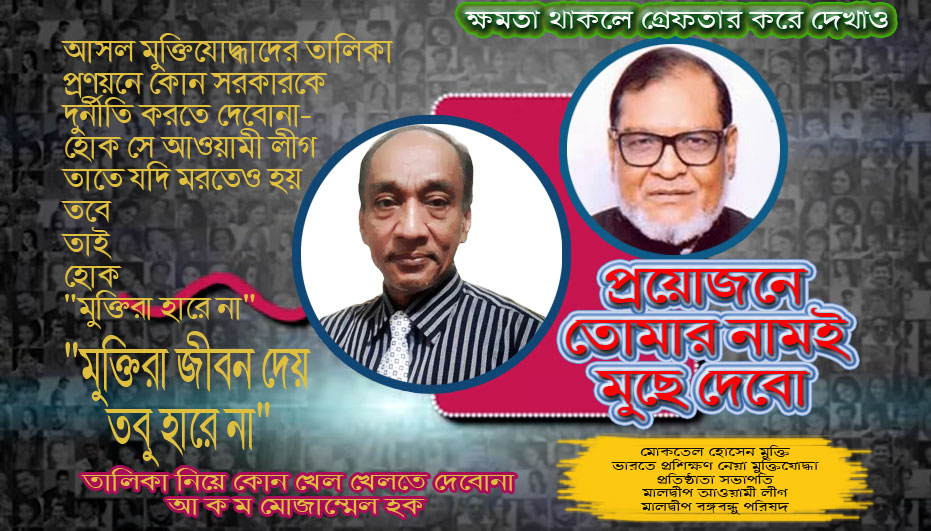
 মুক্তিযুদ্ধ ও মুক্তিযোদ্ধাদের নিয়ে খেলতে দেবোনা