President Ziaur Rahman did not allow me to enter our Dhanmondi-32 Residence:
Sheikh Hasina
Tears rolled down her cheeks and emotion gripped the audience as Prime Minister Sheikh Hasina narrated the massacre at Dhanmondi-32 and unkind behaviour of a government after the assassination of Bangabandhu Sheikh Mujibur Rahman on August 15, 1975.
“When I came back in 1981 from exile, the then government of president Ziaur Rahman did not allow me to enter our Dhanmondi-32 residence where my father along with most of my family members were brutally killed,” she said.
Speaking at a prize giving ceremony at Osmani Memorial Auditorium yesterday morning, she said even General Zia did not allow her to organise a milad mahfil seeking eternal peace of the martyrs of August 15 inside the residence.
“It was Zia who forced us to hold milad on the road for my parents and others who were killed in the August 15 massacre,” said Hasina.
Sheikh Hasina, the eldest daughter of Bangabandhu, who along with her younger sister survived the massacre, described as crime against humanity, said president Zia imposed restriction on opening of the residence from where Bangabandhu led all anti-autocratic movements.
Later, the government led by Justice Abdus Satter opened the historic house and handed over it to Hasina. “When I entered the house, I saw dried blood everywhere and clothes and other valuables were seen scattered on the floor”.
The killers not only killed the country’s founding father along with most of his family members, they also looted all valuables from the house, Hasina said.
There was pin-drop silence in the Osmani Memorial auditorium when the premier was narrating the tale of the blackest chapter of the world’s history. People specially the children who joined the function were seen to wipe their eyes when she was describing the barbaric incident.
Hasina said after receiving the house, she and her younger sister decided to make it a museum for the people of the country. “I thought that the people of the country are the owner of the house as Bangabandhu launched all of his pro-people movements from the house,” she added.
The premier said she inaugurated the Bangabandhu Memorial Museum on August 14, 1994 and after that the museum remains opened for public.
Later, Father of the Nation Bangabandhu Memorial Trust was formed on April 11, 1994 with an aim to provide various services for the common people.
According to sources, 1,000-1,200 students are being provided stipend from the trust each month to meet their education expenses. The trust arranged free medical services across the country from Jan 10 to March 17 this year when over 8 lakh patients were given medical services.
The trust will set up a medical college and a nursing institute in Gazipur to provide medical services for the common people.
The Convenor of Bangabandhu Memorial Museum presided over the function while Curator of the museum Syed Siddiqur Rahman, DG of Bangla Academy Prof Shamsuzzaman Khan and Vice-Chancellor of National University Kazi Shahidullah, among others, addressed it.
Bangladesh’s history in its first decade of freedom was fundamentally a story of bloodletting. You do not have to go into research to arrive at such a morbid conclusion. But you cannot escape feeling a certain sense of irony as you recapitulate the whole episode of the country’s actually claiming, and taking, its place in the global community. If the war of liberation in 1971 saw three million Bengalis dying at the hands of the Pakistan armed forces, the post-liberation era turned into a long tale of blood and gore as most of the new nation’s founding fathers and war heroes bit the dust through bloody coups d’etat and internecine armed conflict. The series of tragic happenings that engulfed Bangladesh between August and November 1975, followed by the execution of Abu Tahir, a soldier for freedom, in July 1976, will remain a blot on the conscience of a nation which yet struggles to find a way out of the woods for itself.
In May 1981 came the assassination of General Ziaur Rahman, Bangladesh’s first military dictator, at the hands of soldiers who in the event could not quite succeed in pulling off what they had thought would be a revolution. Within days of Zia’s murder, it would be the turn of General M.A. Manzoor, ostensibly the leader of the uprising, to be killed in cold blood by Zia loyalists. All of this is what the country has known over the years. In times that are as far removed from the 1970s and 1980s as they can be, that are clearly a whole lot more transparent than what one could have imagined two or three decades ago, it is now possible for Bengalis to grasp a little more conclusively the factors — intrigues, conspiracy, et al — that went into the making of an era that remains sinister in its elemental darkness. And into this story now steps Zayadul Ahsan with his hair-raising account of a failed coup that, once the plot failed to take off, was to leave scores upon scores of soldiers dead after October 1977. Originally conceived and presented as a series of investigative reports for the daily Bhorer Kagoj by the writer, this work is a searing account of the innocent men of the Bangladesh air force who were forced to march to the gallows on flimsy, unproven charges of complicity in the revolt that left some senior and reputed officers of the BAF murdered at the old Tejgaon airport on 2 October 1977. And those were exciting times, not so much for the fact that the struggle for ascendancy among the various politicised factions of the military went on in a seemingly endless pattern as for the truth of what was happening around the hijacked Japan Airlines aircraft at Dhaka airport.
The conspirators struck at the precise moment when senior air force men, including their chief Abdul Gaffar Mahmood, remained busy in negotiations with the Red Brigade who had seized the plane and forced it to land in Bangladesh’s capital. Competent officers, among whom was Ross Masood, were lined up by rebellious air force men before the hangar and simply mown down. The question remains, though: did these men, egged on by individuals whose identities remain yet unknown, decide to strike on 2 October because the opportunity to stage their coup on 28 September, air force day, was lost when President Ziaur Rahman informed Air Vice Marshal Mahmood he was unable to be part of the celebrations? Ahsan comes up with a hint: Egyptian President Anwar Sadat, meeting Zia in Cairo days before 28 September, warned him of a plot to assassinate the Bangladesh leader over the next few days. Zia took the hint seriously; and then came the suddenness of the JAL hijacking. As the talks with the Red Brigade neared an end, elements in the army and air force inside Dhaka cantonment went on the offensive against the Zia regime. A day earlier, in Bogra, disturbances in the cantonment left one person dead, three wounded and two missing. In Dhaka, at Tejgaon airport, eleven air force officers were murdered alongside ten soldiers from the army. Forty soldiers were left injured.
The facts Zayadul Ahsan presents are set off in an eerie pattern from the moment Zia loyalists, Mir Shawkat Ali for instance, move resolutely against the mutineers. Over the next twenty days or so, it would be an operation of relentless cruelty as the Zia regime, guided by vindictiveness and palpably oblivious to all norms of civilised behaviour, rounded up hundreds of innocent air force men and inaugurated what would eventually turn into a story of unimaginable horror. Kangaroo courts, officially described as military tribunals, swiftly handed down verdicts of guilty on those taken into custody; and night after night, inside the grim premises of the central jail in the capital, the bodies of hanged men dropped into pits for hours on end. It was Azimpur graveyard which, throughout October 1977, saw brisk nocturnal activity as the dead men were hastily buried, unbeknownst to their families. The case of the widow Aleya remains poignant, and heart-wrenching. In the days and weeks following his disappearance, she moved heaven and earth for news of her airman husband who had gone missing after 2 October. No one deigned to keep her informed until much later, to let her know in a terse notification that he had been executed for his part in the ‘conspiracy’. There are other accounts, from men who were among the lucky few to escape the noose but nevertheless found themselves condemned to varied terms of imprisonment. The strand of thought throughout the stories runs along similar patterns. The innocent paid for crimes they did not commit; and ruthlessness was what the Zia military dictatorship employed in its efforts to survive and to ensure that no dissent remained to threaten its grip on power. Ironically, the fearsome Zia was to die in a botched coup slightly over three years later.
Zayadul Ahsan’s work is much more than a record keeping of one of the more shameful episodes in the nation’s history. It is, in very large measure, a call for those who perpetrated the atrocities on the hundreds of innocent men in the armed forces in light of the 2 October 1977 tragedy to be brought to account. Most of the men who presided over the sham trials of these men, sending them to quick death and putting a few others through inexplicable prison terms, are still alive. Some retired as senior officers in the military, especially in the air force. Others, non-commissioned officers who cheerfully served on the tribunals, went on to serve in the forces till their retirement. In the overweening interest of democratic accountability, all these elements responsible for the horrific executions in the dark need to be traced in order to be brought to justice. Ahsan’s work is an eye-opener. It is a warning against men who, in the manner of Ziaur Rahman, think nothing of shooting people down in order to entrench themselves in political illegitimacy.
Syed Badrul Ahsan is Editor, Current Affairs, The Daily Star.
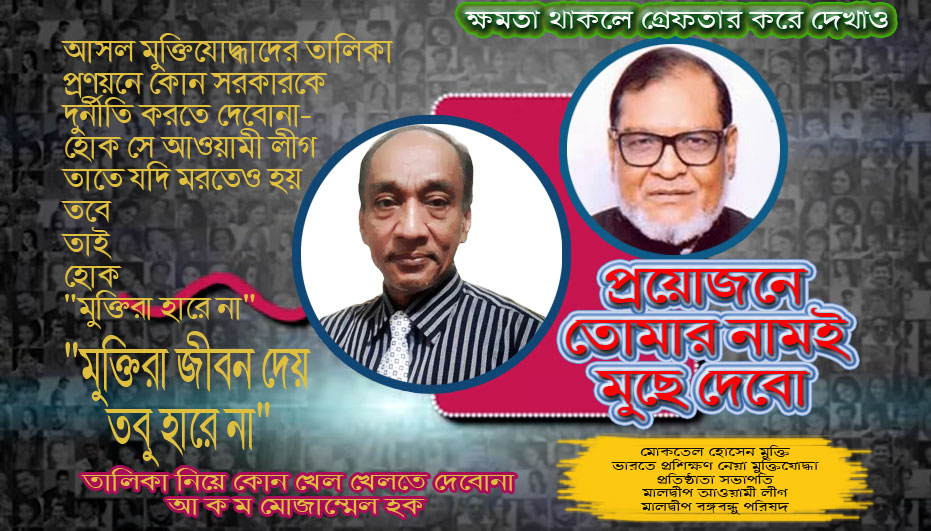
Published by Freedom Fighter Moktel Hossain Mukthi
http://shomoy71.blogspot.com/
http://august75tragedy.blogspot.com/
http://extremistinbangladesh.blogspot.com/
http://theunfinishedmemoirs.blogspot.com/
http://bdslumdogmillionaire.blogspot.com/
http://daughterofdemocracy.blogspot.com/
http://mujibnagar71.blogspot.com/
http://shomoyekattur.blogspot.com/
http://myhomemyglory.blogspot.com/
http://mukthiibangalee.blogspot.com/
http://godfathertareqzia.blogspot.com/
http://burningbengalination.blogspot.com/
http://joydigitalbangla.blogspot.com/
http://thetrueteller.blogspot.com/
http://bangabandhuporisadmv.blogspot.com/
http://notesofmukthi.blogspot.com/
http://lifeandliability.blogspot.com/
http://maldivesawamijuboleague.blogspot.com/
http://muktimadaripuri.blogspot.com/
http://moktelhossainmukthi.blogspot.com/
http://moktelhossainmukthi.weebly.com/
http://narrowpolitics.blogspot.com/
http://bdawamileague.wordpress.com/
http://creationofmukthi.blogspot.com/
http://misrulesofbnpjamat.wordpress.com/
http://en.netlog.com/Muktishena71/
http://masterminds75.webs.com/
http://sheikhhasina.blog.com/
http://skhasinawajed.blogspot.com/
http://deshratna.weebly.com/
http://sheikhhasina.webs.com/
http://bangladeshstudentleague.blog.com/
http://advskhatun.webnode.com/
http://daughterofthedemocracy.blogspot.com/
http://bangabandhuporisadmv.blogspot.com/
http://thegreatestbangalee.blogspot.com/
http://theburningnation.weebly.com/
http://jathirpitha.wordpress.com/
http://skmujiburrahman.blogspot.com/
http://bangabandhu.weebly.com/
http://swadhinbangla.webs.com/
http://amibangalee.webs.com/
http://bangabandhuporisad.webs.com/
http://bangabandhu.webs.com/
http://august75tragedy.blogspot.com/
http://thefatherofnation.blogspot.com/
http://mujibshena.blogspot.com/
http://charterofchange.blogspot.com/
http://bangladeshawamileague.blog.com/
http://bangladeshawamileague.webs.com/
http://worldawamileague.blogspot.com/
http://charterofchange.blogspot.com/
http://charterofchange2021.blogspot.com/
http://digitalbangladesh.blog.com/
http://thepatriotism.blog.com/
http://bdpolitics.blog.com/
http://mukthi.tumblr.com/archive
http://mukthi.tumblr.com/muktimusician
http://thegenerationnext.webs.com/
http://thefutureleaderjoy.wordpress.com/
http://thefutureleader.webnode.com/
http://jajaborpakhi.blog.com/
http://muktimusician.livejournal.com/
http://moktelhossainmukthi.blog.com/
http://mukthi.xanga.com/
http://muktimusician.blog.co.in/
http://www.ustream.tv/channel/moktel-hossain-mukthi
http://muktirpata.blogspot.com/
http://muthirpachali.blogspot.com/
http://mukthimadaripuri.blog.co.in/
http://amarmonmanena.webs.com/
http://mukthi.webnode.com/
http://muktirpata.weebly.com/
http://khasherhat.blogspot.com/
http://soundcloud.com/muktimusician
http://muktimusician.multiply.com/
http://muktimusician.xanga.com/
http://muktimusician.dinstudio.com/
http://muktishena71.typepad.com/
http://muktishena71.webnode.com/
http://muktimusician.typepad.com/
http://muktimusician.posterous.com/
http://amramujibshena.blog.com/
http://muktimusician.blog.com/
http://muktimusician.stumbleupon.com/
http://muktimadaripuri.blogspot.com/
http://muktimusician.blogspot.com/
http://mukthircollection.blogspot.com/
http://muktimusician.photobucket.com/
http://bentio.com/muktimusician
http://muktimusician.wordpress.com/
http://muktishena71.bloggy.se/
http://bd.linkedin.com/in/muktimusician
http://mukthirpachali.blog.com/
http://muktimusician.myblogsite.com/
http://friendfeed.com/muktimusician
http://muktimusicina.twitpic.com/
http://muktimusician.mediashare.com/
http://freedomfighters71.blogspot.com/
http://muktimusician.imgur.com/
http://muktimusician.picturepush.com/
http://community.webshots.com/user/muktimusician
http://hawabhaban.blog.com/
http://misrulesofbnpjamat.webnode.com/
http://misrulesofbnpjamat.blogspot.com/
http://warcrime1971.webs.com/
http://warcrime1971.blogspot.com/
http://warcrime1971.weebly.com/
http://khaledaziaandrazakars.wordpress.com/
http://warcriminalsinbangladesh.wordpress.com/
http://warcriminalsinbangladesh.blogspot.com/
http://warcriminalnizami.blogspot.com/
http://warcriminalsakachoudhury.blogspot.com/
http://godfathertareqzia.blogspot.com/
http://nospaceforwarcriminal.blogspot.com/
http://razakarnizami.blogspot.com/
http://barristertaposhfanclub.blogspot.com/
http://en.wikipedia.org/wiki/Muktimusician
http://blogtown.co.nz/muktimusician/
http://priyo.com/muktimusician
http://en.netlog.com/Muktishena71
www.thoughts.com/muktimusician
www.myspace.com/muktimusician
www.orkut.com/warcriminalsinbangladesh
www.warcriminalsinbangladesh.hi5.com
www.netlog.com/muktimusician
www.blogigo.co.uk/muktimusician
www.picasaweb.com/muktimusician
www.orkut.com/muktimusician
www.muktimusician.hi5.com
www.tagged.com/mukthimadaripuri
www.tagged.com/amibangali
www.tagged.com/muktimusician
www.tagged.com/deshratna
www.tagged.com/muktithegreat
www.tagged.com/amibangali
www.squidoo.com/muktimusician
www.youtube.com/muktimusician
www.shtyle.fm/muktimusician
www.myspace.com/muktimusician
www.orkut.com/muktimusician/
http://vodpod.com/muktimusician
www.quepasa.com/muktimusician
www.caringbridge.org/muktimusician
www.bebo.com/muktimusician
www.hibuu.com/muktimusician
www.twitter.com/muktimusician
www.zimbio.com/member/muktimusician
www.blogigo.co.uk/muktimusician
www.playlist.com/muktimusician
www.youtube.com/muktisena71
www.youtube.com/nizami71
www.youtube.com/muktimusician
www.dailymotion.com/muktimusician
www.facebook.com/deshratna2009
www.facebook.com/jatirjanokbangabandhu
www.facebook.com/thebrokenbackbone
www.facebook.com/proggasrijanikhelaghor
www.facebook.com/bangabandhu.parisod
www.facebook.com/durnithi.rajnithi
www.facebook.com/shadhinatha
www.facebook.com/deshratna2009
www.facebook.com/sheikhrussellrahman
www.facebook.com/bnpjamat20012006
www.facebook.com/mukthijajabor
www.facebook.com/pakifannydogs
Email ID:
muktimusician@gmail.com
muktimusician@usa.com
muktimusician@europe.com
muktibhai@hotmail.com
mukthimadaripuri@gmail.com
muktimadaripuri1953@yahoo.com
muktishena71@gmail.com
mujibshena@yahoo.com
deshratna2009@gmail.com
muktisena71@yahoo.com
m.ukthi@live.com
sheikhrussell@live.com
Mukti Bahini (Ekatturer beer shenanee) "Liberation Army"), also termed as the "Freedom Fighters" or FFs, was a guerrilla force which fought against the Pakistan Army during the Bangladesh Liberation War in 1971.
Mukti Bahini (Bengali: মুক্তি বাহিনী "Liberation Army"), also termed as the "Freedom Fighters" or FFs, collectively refers to the armed organizations who fought against the Pakistan Army during the Bangladesh Liberation War. It was dynamically formed by (mostly) Bengali regulars and civilians after the proclamation of Bangladesh's independence on March 26, 1971. Subsequently by mid-April 1971 the Bengali officers and soldiers of East Bengal Regiments formed the "Bangladesh Armed Forces" and M. A. G. Osmani assumed its command. The civilian groups continued to assist the armed forces during the war. After the war "Mukti Bahini" became the general term to refer to all forces (military and civilian) of former East Pakistani origin fighting against the Pakistani armed forces during the Bangladesh Liberation War. Often Mukti Bahini operated as an effective guerrilla force to keep their enemies on the run. Inspired in part by revolutionary Che Guevara,[1] they have been compared to the French Maquis, Viet Cong, and the guerrillas of Josip Broz Tito in their tactics and effectiveness.[2]
Contents [hide]
1 Origins
2 Organization during war
3 Regular and irregular forces
3.1 Bangladesh Navy
3.2 Bangladesh Air Force
3.3 Independent forces
3.4 Leftist factions
4 Broadcast warriors
5 Sectors of Liberation War
6 Mukti Bahini in the final phase
7 See also
8 References
9 Further reading
10 External links
[edit]Origins
Although Mukti Bahini was formed to fight off the military crackdown by the Pakistan army on March 25, 1971 during the climax of Bangladesh freedom movement, The crisis had already started taking shape with anti-Ayub uprising in 1969 and precipitated into a political crisis at the height of Sheikh Mujibur Rahman's Six-point movement beginning in the 1970s. In March 1971, rising political discontent and cultural nationalism in what was then East Pakistan (later, Bangladesh) was met by harshsuppressive force from the ruling elite of the West Pakistan establishment in what came to be termed Operation Searchlight.
The massive crackdown by West Pakistan forces became an important factor in precipitating the civil war as a sea of refugees (estimated at the time to be about 10 million) came flooding to the eastern provinces of India.Facing a mounting humanitarian crisis, India started actively aiding and re-organising what was by this time already the nucleus of the Mukti Bahini.
The immediate precursor of the Mukti Bahini was Mukti Fauj ("Fauj" is the Urdu originally from Persian borrowed from Arabic for "Brigade" exported into several languages in South Asia including Bengali), which was preceded denominationally by the sangram parishads formed in the cities and villages by the student and youth leaderships in early March 1971. When and how the Mukti Fauj was created is not clear nor is the later adoption of the name Mukti Bahini. It is, however, certain that the names originated generically refer to the people who fought in the Bangladesh liberation war.
Since the anti-Ayub uprising in 1969 and during the height of Mujib's six points movement, there was a growing movement among the Bengalis in East Pakistan to become independent driven by the nationalists, radicals and leftists. After the election of 1970, the subsequent crisis strengthened that feeling within the people. Sheikh Mujib himself was facing immense pressure from most prominent political quarters, especially the ultra-nationalist young student leaders, to declare independence without delay. Armed preparations were going on by some leftist and nationalist groups, and the Bengali army officers and soldiers were prepared to defect. At the call of Sheikh Mujibur Rahman the people of East Pakistan joined in a peaceful movement for non-cooperation from 3 March 1971, and 7th march and onward, which lasted up to midnight of 25 March 1971. On this date the Pakistani Army cracked down upon unarmed civilians to take control of the administration. During the army crackdown on the night of March 25, 1971, there were reports of small scale resistance notably at Iqbal Hall, Dhaka University and at the Rajarbagh Police Headquarter. The latter initially put a strong fight against the Pakistan Army. As political events gathered momentum, the stage was set for a clash between the Pakistan Army and the Bengali people vowing for independence. Bengali members of the Army were also defecting and gathering in various pockets of the country.
All these early fights were disorganized and futile because of the greater military strength of the Pakistani Army. Outside of Dhaka, resistance was more successful. The earliest move towards forming a liberation army officially came from the declaration of independence made by Major Ziaur Rahman of East Bengal Regiment on behalf of Sheikh Mujibur Rahman. In the declaration made from Kalurghat Betar Kendra (Chittagong) on March 27, 1971, Zia assumed the title of "provisional commander in chief of the Bangladesh Liberation Army", though his area of operation remained confined to Chittagong and Noakhali areas. Major Ziaur Rahman's declaration on behalf of Sheikh Mujibur Rahman marked a break with Pakistan by the Bengali units of the army.
[edit]Organization during war
See Also: Mujibnagar Government
Though prolonged Bengali resistance was not anticipated by Pakistani planners of Operation Searchlight,[9], when the Pakistani Army cracked down upon the population, the Mukti Bahini were becoming increasingly visible. Headed by Colonel (later, General) M. A. G. Osmani, a retired Pakistani Army officer, this band was raised as Mujib's action arm and security force before assuming the character of a conventional guerrilla force. After the declaration of independence, the Pakistani military sought to quell them, but increasing numbers of Bengali soldiers defected to the underground "Bangladesh army". These Bengali units slowly merged into the Mukti Bahini and bolstered their weaponry.
On April 12, 1971 Colonel (later General) M. A. G. Osmani assumed the command of armed forces at Teliapara (Sylhet) headquarters. Osmani was made the commander-in-chief of Bangladesh Armed Forces on April 17, 1971. Serious initiative for organising the Bangladesh liberation army was taken between 11-17 July. In a meeting of the sector commanders in Kolkata, four important resolutions were taken in consideration of strategic aspects of the war, existing problems and future course of resistance. These were:
Composition and tactics of the combatants would be as follows:
Guerrilla teams comprising 5 to 10 trained members would be sent to specific areas of Bangladesh with specific assignments
Combat soldiers would carry out frontal attacks against the enemy. Between 50 and 100 per cent would carry arms. Intelligence volunteers would be engaged to collect information about the enemy. 30 percent of these people would be equipped with weapons;
The regular forces would be organised into battalions and sectors.
The following strategies would be adopted while carrying out military operations against the enemy
A large number of guerrillas would be sent out inside Bangladesh to carry out raids and ambushes;
Industries would be brought to a standstill and electricity supply would be disrupted;
Pakistanis would be obstructed in exporting manufactured goods and raw materials;
Communication network would be destroyed in order to obstruct enemy movements;
Enemy forces would be forced to disperse and scatter for strategic gains;
The whole area of Bangladesh would be divided into 11 sectors.
Other than the organizations of Mukti Bahini who were generally trained and armed by the Indian Army, there were independent guerrilla groups led by individual leaders, either nationalists or leftists, who were successfully controlling some areas.
Regular and irregular forces
Leaflets and pamphlets played an important role in driving public opinion during the war.
The regular forces later called Niomita Bahini (regular force) consisted of the members of the East Bengal Regiments (EBR), East Pakistan Rifles (EPR, later BDR), police, other paramilitary forces and the general people who were commanded by the army commanders in the 11 sectors all over Bangladesh. Three major forces: Z-Force under the command of Major (later, Major General) Ziaur Rahman, K-Force under Major (later Brigadier ) Khaled Mosharraf and S-Force under Major (later Major General) K M Shafiullah were raised afterwards to fight battles in efficient manners. The irregular forces, generally called Gono Bahini (people's army), were those who were trained more in guerrilla warfare than the conventional one.
The irregular forces, which after initial training joined different sectors, consisted of the students, peasants, workers and political activists. Irregular forces were initiated inside Bangladesh province to adopt guerrilla warfare against the enemy. The regular forces were engaged in fighting the usual way.
The Mukti Bahini obtained strength from the two main streams of fighting elements: members of armed forces of erstwhile East Pakistan and members of the urban and rural youths many of whome were volunteers. Other groups included members of sangram parishads, youth and student wings of Awami League, NAP, Leftist-Communist Parties and radical groups. The Mukti Bahini had several factions. The foremost one was organized by the members of the regular armed force, who were generally known as Freedom Fighters (FF). Then there was Bangladesh Liberation Forces (BLF) led by four youth leaders of the political wing of Sheikh Mujib's Awami League and the third one generally known as Special Guerrilla Forces (SGF) led by the Communist Party of Bangladesh, National Awami Party, and Bangladesh Students Union. They then jointly launched guerrilla operations against the Pakistani Army causing heavy damages and casualties. This setback prompted the Pakistani Army to induct Razakars, Al-Badrs and Al-Shams (mostly members of Jamaat-e-Islami and other Islamist groups), as well as other Bengalis who opposed independence, and Biharis who had settled during the time of partition. This helped Pakistan stem the tide somewhat as the monsoon approached in the months of June and July.
[edit]Bangladesh Navy
Bangladesh Navy was constituted in August 1971. Initially, there were two ships and 45 navy personnel. These ships carried out many successful raids on the Pakistani fleet. But both of these ships were mistakenly hit and destroyed by Indian fighter planes on 10 December 1971, when they were about to launch a major attack on Mongla seaport.
[edit]Bangladesh Air Force
Bangladesh Air Force started functioning on 28 September at Dimapur in Nagaland, under the command of Air Commodore AK Khondakar. Initially, it consisted of 17 officers, 50 technicians, 2 planes and 1 helicopter. The Air Force carried out more than twelve sorties against Pakistani targets and was quite successful during the initial stages of the Indian attack in early December.
[edit]Independent forces
In addition, there were also some independent forces that fought in various regions of Bangladesh and liberated many areas. These included Mujib Bahini which was organized in India. Major General Oban of the Indian Army and Student League leaders Serajul Alam Khan, Sheikh Fazlul Haque Mani, Kazi Arif Ahmed, Abdur Razzak, Tofael Ahmed, A. S. M. Abdur Rab, Shahjahan Siraj, Nur E Alam Siddiqi, and Abdul Quddus Makhon were organisers of this Bahini. There was the Kaderia Bahini under Kader Siddique of Tangail, Afsar Bahini and Aftab Bahini of Mymensingh, Latif Mirza Bahini of Sirajganj, Akbar Hossain Bahini of Jhinaidah, Quddus Molla and Gafur Bahini of Barisal, Hemayet Bahini under Hemayet Uddin of Faridpur. There were also several communist/leftist groups who clashed with the Pakistan Army, and controlled some areas independently.
[edit]Leftist factions
In addition,there were some other groups of freedom fighters which were controlled by the Leftist parties and groups including the NAP and Communist Parties. Among others, Siraj Sikder raised a strong guerrilla force which fought several battles with the Pakistani soldiers in Payarabagan, Barisal. Although there were ideological conflicts among the communist parties (most notably, split into pro-soviet and pro-Chinese factions and widespread split within the pro-Chinese faction) on deciding a common action in the context of Bangladesh Liberation, many of the individuals and leaders of Mukti Bahini were deeply influenced by the leftist ideology in general. There were strong concerns among the Indian authority and members of the Awami League led provisional government not to lose the control of the liberation war to the leftists. Nevertheless many leftists overcame these internal and external difficulties and actively participated in the Liberation war with the main nucleus of the Mukti Bahini.
Broadcast warriors
Performers at Swadhin Bangla Betar Kendra like M. R. Akhtar Mukul, Apel Mahmud Gopal C. Talukder (Singer), Abdul Jabbar (Singer), Mohammad Shah were great inspirations for the freedom-fighters in 1971, and were considered to be Broadcast Warriors.
Sectors of Liberation War
The eleven sectors
Main article: List of Sectors in Bangladesh Liberation War
Immediately after formation, the new government of Bangladesh shifted its focus on organizing the war against Pakistan Army. A Cabinet meeting of Bangladesh government on July 11, 1971 appointed Col. M. A. Gopal. Osmani as Commander in Chief, Lt. Col. Abdur Rab as Chief of Army Staff and Group Captain A K Khandker as Deputy Chief of Army Staff and Chief of Air Force.
In this meeting Bangladesh was divided into Eleven Sectors and each Sector was assigned a Sector Commander. The 10th Sector was directly placed under the Commander in Chief (C-in-C) and included the Naval Commandos and C-in-C’s special force.
The Sector Commanders were chosen from defected officers of Pakistan army who joined the Mukti Bahini. These trained officers directed the guerrilla warfare as well as trained the independence militia who lacked formal training on military operations. Most of these training camps were situated near the border area and were operated with direct assistance from India.
For better efficiency in combat operations, each of the sectors were divided into a number of sub-sectors. The table below provides a list of the sectors along with the name of the sector commanders.
Sectors of Bangladesh Liberation War
Sector Area Sector Commander
1 Chittagong District, Chittagong Hill Tracts, and the entire eastern area of the Noakhali District on the banks of the river Muhuri. Major Ziaur Rahman, later replaced by Major Rafiqul Islam
2 Districts of Dhaka, Comilla, Faridpur, and part of Noakhali District. Major Khaled Mosharraf, later replaced by Major ATM Haider
3 Area between Churaman Kathi (near Sreemangal) and Sylhet in the north and Singerbil of Brahmanbaria in the south. Major KM Shafiullah, later replaced by Major ANM Nuruzzaman.
4 Area from Habiganj District on the north to Kanaighat Police Station on the south along the 100 mile long border with India. Major Chittarajan Datta, later replaced by Captain A Rab.
5 Area from Durgapur to Danki (Tamabil) of Sylhet District and the entire area up to the eastern borders of the district. Major Mir Shawkat Ali
6 Rangpur District and part of Dinajpur District. Wing Commander M Khademul Bashar
7 Rajshahi, Pabna, Bogra and part of Dinajpur District. Major Nazmul Huq, later replaced by Subedar Major A Rab and Kazi Nuruzzaman.
8 In April 1971, the operational area of the sector comprised the districts of Kushtia, Jessore, Khulna, Barisal, Faridpur and Patuakhali. At the end of May the sector was reconstituted and comprised the districts of Kuhstia, Jessore, Khulna, Satkhira and the northern part of Faridpur district. Major Abu Osman Chowdhury, later replaced by Major MA Manzur.
9 Barisal, Patuakhali, and parts of the district of Khulna and Faridpur. Major M A Jalil later replaced by Major MA Manzur and Major Joynal Abedin.
10 This sector was constituted with the naval commandos. Indian commander MN Sumanta.
11 Mymensingh and Tangail. Major M Abu Taher, later replaced by Squadron Leader Hamidullah.
Source: Sectors of the War of Liberation; Shirin, S. M.; Banglapedia.
[edit]Mukti Bahini in the final phase
The liberation forces started carrying out massive raids into enemy fronts from October 1971. After the signing of the Indo-Soviet Treaty in August 1971, India began to demonstrate more interest in the Bangladesh war. Eventually India legally entered the war on 3 December 1971 (Indo-Pakistani War of 1971) after Pakistan's preemptive air raids on some Indian cities in the western border. In fact, the Indian soldiers were already participating in the war in different guises since November when the independence fighters had launched the Belonia battle. When the Indian Army planned to avoid battles and seize the capital Dhaka in the shortest campaign possible, the Mukti Bahini made the task much easier by confining the Pakistani army and holding them back from moving towards to capital.
Despite the difficult terrain of Bangladesh, the war was won rapidly. Dhaka was liberated in a matter of two weeks. The Mukti Bahini were a major contributing factor in the Indian Victory fighting both as irregulars, and as conventional forces alongside the Indians. Several actions in the heart of the capital and the killing of Monaem Khan, a loyalist, anti-Bengali and ex-governor of East Pakistan, proved the effectiveness and capability of the guerrillas.
On 16 December 1971, commander of the 14 division of Pakistan army Major General Jamshed surrendered to Indian General Nagra near Mirpur bridge in Dhaka. At 10.40 am, the Indian allied force and Kader Siddique entered Dhaka city. That signaled the end of the 9-month long War of Liberation of Bangladesh. Scattered battles were still waged at various places of the country.
The Commander of Eastern Command of the Pakistan Army, Lt. General A. A. K. Niazi surrendered to the commander of the joint Indo-Bangladesh force and the chief of Indian eastern command Lt. General Jagjit Singh Arora. The Bangladesh Forces were represented at the ceremony by Group Captain A. K. Khandker.
[edit]See also
Mitro Bahini
^ Dangerous Liaison by Raza Naeem, Frontline, Volume 26 - Issue 15, July 18–31 2009
^ Why the Movement for Bangladesh Succeeded: A military appreciation by Mumtaz Iqbal
^ Genocide in Bangladesh, 1971. Gendercide Watch.
^ Emerging Discontent, 1966-70. Country Studies Bangladesh
^ Anatomy of Violence: Analysis of Civil War in East Pakistan in 1971: Military Action: Operation Searchlight Bose S Economic and Political Weekly Special Articles, October 8, 2005
^ The Pakistani Slaughter That Nixon Ignored , Syndicated Column by Sydney Schanberg, New York Times, May 3, 1994
^ a b Crisis in South Asia - A report by Senator Edward Kennedy to the Subcommittee investigating the Problem of Refugees and Their Settlement, Submitted to U.S. Senate Judiciary Committee, November 1, 1971, U.S. Govt. Press.pp6-7
^ India and Pakistan: Over the Edge. TIME Dec 13, 1971 Vol. 98 No. 24
^ Pakistan Defence Journal, 1977, Vol 2, p2-3
^ Bangladesh Liberation Armed Force, Liberation War Museum, Bangladesh.
Jagjit singh Arora
Edit
Other Names
একাত্তুরের মুক্তিসেনা
Options
Nickname · Shown at top of profile
সময় একাত্তুর
Options
Nickname
muktimusician
Options
Nickname
তবু মনে রেখো
Options
Other
Add a nickname, a birth name...
Favorite Quotes
Ami Fashir Monce DaRie Bolbo " aMi BangaLi, BangLa aMar VaSha, AmaR DeSh, BangLaDesh" Sheikh Mujibur Rahman"
আমি ফাঁসির মঞ্চে দারীয়ে বলবো " আমি বাঙালি, বাংলা আমার ভাষা, আমার দেশ- বাংলাদেশঃ শেখ মুজিবুর রহমান
"রাজাকার হওয়া সহজ
মুক্তিযোদ্ধা থাকাই বড় কঠিন"
View more posts
 মুক্তিযুদ্ধ ও মুক্তিযোদ্ধাদের নিয়ে খেলতে দেবোনা