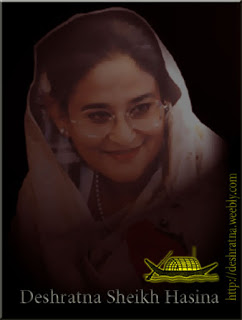
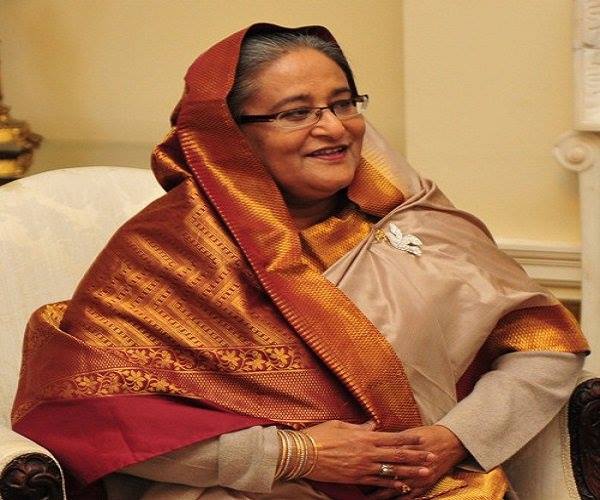
SHEIKH HASINA
Honorable Prime Minister of People’s Republic of Bangladesh(2nd term), was born on 28 September, 1947 at Tungipara under Gopalganj district. She is the eldest of five children of the Father of the Nation Bangabandhu Sheikh Mujibur Rahman, the founder of independent Bangladesh.She graduated from the University of Dhaka in 1973. She was elected Vice President of the Students Union of Government Intermediate Girl’s College. She was a member of the students League Unit of Dhaka University and Secretary of the Students League Unit of Rokeya Hall. She actively participated in all the mass movements since her student life.
Fatherof the Nation Bangabandhu Sheikh Mujibur Rahman along with the members of his family was martyred on the fateful night of 15 August 1975. Sheikh Hasina and her younger sister Sheikh Rehana were the only survivors as they were in West Germany at that time. Later she went to the United Kingdom from where she started her movement against the autocratic rule in 1980. Sheikh Hasina was unanimously elected President of Bangladesh Awami League in 1981 in her absence, while she was forced to live in exile in New Delhi. Ending six years in exile, she returned home finally on 17 May 1981.In the parliamentary election held in 1986, she won three seats. She was elected Leader of the Opposition. She led the historic mass movement in 1990 and announced the constitutional formula for peaceful transfer of power through Articles 51 and 56 of the Constitution.Following the election of 1991 Sheikh Hasina became Leader of the Opposition in the country’s Fifth Parliament, She steered all the political parties in the parliament towards changing the Presidential system into the Parliamentary one.Sheikh Hasina created awareness among the people and waged a struggle for Non-party Caretaker Government to ensure free and fair polls. Her movement reached the peak after a non-cooperation movement in March 1996 and the provision for Non-party Caretaker Government was incorporated in the Constitution.At the call of Sheikh Hasina a large number of people of all walks of life expressed solidarity with the movement at the ‘Janatar Mancha’. In the Parliamentary election held on 12 June 1996, Bangladesh Awami League emerged as the majority party and she assumed the office of the Prime Minister of Bangladesh on 23 June 1996.After becoming the Prime Minister, Sheikh Hasinaadopted a number of pragmatic policies for overall development of the nation including poverty alleviation. During the last four years her government achieved laudable success including signing of the historic 30 year Ganges Water Sharing Treaty with India, signing of historic peace Accord on Chittagong Hill Tracts and inauguration of the Bangabandhu Bridge on the river Jamuna.Sheikh Hasina was conferred Degree of Doctor of Law by the Boston University of the USA on 6 February 1997 and Honorary Doctor of Law by the Waseda University of Japan on 4 July 1997. She was also conferred the Honorary Doctorate of Philosophy in Liberal Arts by University of Abertay Dundee of the United Kingdom on 25 October, 1997. She was conferred Honorary Degree of Desikottama (Doctor of Literature, honoris causa) by Visva-Bharati University of West Bengal, India on 28 January 1999. She was also conferred the degree of Doctor of Laws, honoris causa, on the ground of her distinguished creative contributions in the service of society by the Australian National University on 20 October 1999. Dhaka University conferred Honorary ‘Doctor of Laws’ degree to Sheikh Hasina on 18 December, 1999 for her outstanding contribution towards peace and democracy. The World famous Catholic University of Brussels, Belgium conferred Honorary Doctorate degree (Doctor Honoris Causa) on Sheikh Hasina on 04 February, 2000 for her decisive role in establishing democracy, protecting human rights and peace. Sheikh Hasina has been conferred Honorary Doctor of Humane Letters by the Bridgeport University, USA on 5 September, 2000.Sheikh Hasina has been awarded UNESCO’s Houphouet-Boigny Peace Prize for 1998 for her remarkable contribution to bringing peace through ending the 25 years of conflict in Chittagong Hill Tracts with political courage and statesmanship.Prime Minister Sheikh Hasina received prestigious Pearl S. Buck Award ’99 on 9 April 2000 in recognition of her vision, courage, achievements in political, economic and humanitarian fields by Randolph Macon Women’s College of USA. The UN Food and Agriculture Organization (FAO) has been awarded the prestigious CERES’ medal to Prime Minister Sheikh Hasina in recognition to her fight against hunger on 02 August, 1999. The All India Peace Council awarded her ‘Mother Teresa Award’ in 1998. The Mahatma M K Gandhi Foundation of Oslo, Norway awarded Sheikh Hasina ‘M K Gandhi Award’ for 1998 for her contribution towards promotion of communal understanding, non violent religions harmony and growth of democracy at the level of grassroots in Bangladesh. Sheikh Hasina was named Paul Haris Fellow by the Rotary Foundation of Rotary International. She was also given Medal of Distinction in 1996-97 and 1998-99 and Head of State Medal in 1996-97 by the International Association of Lions Clubs.She has authored several books including
“Why Are They Street Children”, “The Origin of Autocracy”, ‘Miles to Go”, “Elimination of Poverty and Some Thoughts”, “People and Democracy”, “My Dream My Struggle” and “Development for the Masses.” She performed holy Hajj and Umrah several times.Sheikh Hasina is the Chairperson of “The Father of the Nation Bangabandhu Sheikh Mujibur Rahman Memorial Trust”. She has been helping a lot of poor boys and girls for their education.Prime Minister Sheikh Hasina, throughout her life has been a strong proponent of peace, freedom and democracy. From an early age, inspired by the lofty ideals and love for the people of her father, Bangabandhu Sheikh Mujibur Rahman, the liberator of Bangladesh, she developed a strong sense of identity for the common people. She always spoke out against oppression and violation of human rights. This commitment has hardened over the years, particularly when her parents, brothers and scores of relatives were brutally assassinated by the misguided members of the military in 1975 soon after the independence of Bangladesh.Since that time her resolve for democracy and development for the teeming millions of Bangladesh has become firmly entrenched. She struggled for the return of democracy in Bangladesh and fought valiantly for its establishment in the country in every possible manner. She was committed to making Parliament the centre of all national activities.
In 1996, the people of Bangladesh gave her a strong mandate as the Prime Minister of the country. Despite serious resource and constraints and recurrent natural calamity as well as widespread poverty, Prime Minister Sheikh Hasina, during the first two years of her government, has lived up to her unswerving commitment to the cause of peace, democracy, development and human rights.Her first act of peace within months of her assumption of office was the initiative for resolution of the long-standing water-sharing dispute with India through a 30-years treaty. This put an end to a very complex regional dispute.Her visionary idea of a business summit among the political and private sector leaders of Bangladesh, India and Pakistan has added a new chapter in the history of South Asia.Her dedicated leadership also made possible a peace agreement in the Chittagong Hill Tracts, thereby solving the 23-year old insurgency in the Hill districts of Bangladesh. This peace accord brought an area inhabited by nearly 5 million people out of violence and into a time of peace and development. Though the international media has not given much prominence to this accord, it is uniquely remarkable because the peace accord benefited such a large number of people and the whole area has been brought under development programs following the complete surrender of arms by the insurgents.Her quest for peace has taken her to India and Pakistan to talk to the leaders of these two countries soon after the nuclear test urging reduction of tension in the region.Prime Minister Hasina has been a strong advocate for the Culture of Peace at global, regional and national levels. In many major conferences, she espoused the concept of the Culture of Peace, most recently in South Africa at the 12th Summit of the Non-Aligned Movement (NAM) which has a membership of 114 countries. Her initiative has resulted in the first-ever resolution by the Plenary of the United Nations General Assembly on the Culture of Peace. She also provided leadership for the declaration by the UN of the period 2001 to 2010 as the International Decade for Culture of Peace and Non-Violence for the Children of the World.

Prime Minister Hasina’s determination for the eradication of poverty, in particular through wide-ranging microcredit programmes, has been recognized world-wide. Her co-chairpersonship of the Microcredit Summit in February 1997 which resolved to bring 100 million families of the world out of poverty by 2005 focused world attention to her strong commitment to the eradication of poverty and enlistment of the poorest of the poor. She has been a champion of microcredit by spreading the message in major international forums. Her leadership led to the adoption for the first time by UN General Assembly a far-reaching resolution on the role of microcredit in the eradication of poverty.Along with poverty eradication, she has focused on the empowerment of women and has successfully completed legislation to ensure adequate representation of women in the local government bodies, leading to the election of more than 14,000 women to these bodies in 1997. She has taken major initiatives to stop violence against women and children.She has also provided leadership in the field of education, particularly for the education of girls in her own country as well as advocating it for global support. Her government has greatly enhanced budgetary allocation for primary education focusing on girls’ education.To improve the quality of life of the people of Bangladesh, Prime Minister Sheikh Hasina has particularly focused on human development, paying special attention to healthcare, family planning, nutrition, women’s rights and survival and development of children. At the UN and other forums, she has been a major voice in support of the cause of children and their rights.Prime Minister Sheikh Hasina has, all along her life, defended human rights in every possible way. Her active promotion of the rights of women and children has drawn appreciation by both of government and NGOs as well as international organizations. She has promoted the right to development as having centrality in the human rights regime. At the NAM Summit in South Africa in 1998, her proposal for a Convention on the Right to Development received welcoming endorsement of the Heads of State and Government. She initiated the establishment of a National Human Rights Commission and the office of Ombudsperson as well as Bangladesh’s recent accession to six major human rights instruments including the International Covenant on Economic, Social and Cultural Rights.Her keen interest resulted in the signature by Bangladesh of the Statute for the International Criminal Court (ICC) and ratification of the Landmines Treaty, being the first country in South Asia to do so.Prime Minister Sheikh Hasina’s initiative resulted in the hosting of the first-ever conference of the Asian parliamentarians devoted to peace and cooperation in Dhaka in September 1999 which elected her as the first President of the Association of Asian Parliaments for peace established at the conference.At present, as someone who has lost so much personally and has been a victim of oppression and denial of freedom, Prime Minister Sheikh Hasina stands out as a messenger of peace, democracy, development and human rights. Her leadership of the eighth largest country of the world manifests her concern for the people, seen again during the worst-ever floods in Bangladesh in 1998.
§ Sheikh Hasina is the recipient of the UNESCO Houphouet-Boigny Peace Prize for 1998 for her role in bringing peace in the Chittagong Hill Tracts region of Bangladesh.
§ Sheikh Hasina has been awarded the Mahatma Gandhi Award for 1998 (Oslo, Norway) for her contribution towards promotion of communal understanding, non-violence, religio us harmony and growth of grassroots democracy in Bangladesh.
§ She has been awarded 1999 CERES Medal for contribution to the agriculture development by the Food and Agriculture Organization of the United Nations, Rome.
§ She is the winner of the 1999 Pearl S. Buck Award for “your vision, your courage and your achievements in political, economic and humanitarian spheres capture the spirit of the award and of the woman who inspired it.”
§ She has been awarded honorary Doctor of Liberal Arts by the University of Alberta Dundee in the United Kingdom in October 1997.
§ She has been conferred honorary Doctor of Laws by the Boston University in th
e United States and the Waseda University of Japan.
§ She has been conferred the degree of Desikottama (Doctor of Literature) by the Visva-Bharati University, India founded by Nobel Laureate Rabindranath Tagore.
§ She has been conferred honorary Doctor of Laws by the Australian National University in October 1999.
§ Prime Minister Sheikh Hasina has been conferred honorary Doctor of Laws by Dhaka University in December 1999.
§ She has been conferred honorary Doctor of Laws by the Catholic University of Brussels in February 2000.
§ Prime Minister Sheikh Hasina has been conferred by the honorary Doctor of Humane Letters for her contribution to world peace and development by the University of Bridgeport, Connecticut in the United States on 5 September 2000.
Under her leadership her party Bangladesh Awami League led grand alliance to win a landslide victory in the 9th Parliament Election on December 29, 2008 with 262 seats out of 299 in the National Parliament.
Sheikh Hasina took oath as Prime Minister of Bangladesh (2nd term) at a ceremony held at Banghabhaban on January 06, 2009.
Sheikh Hasina has had a mercurial political career
Profile: Sheikh Hasina
The life of Bangladesh Awami League leader Sheikh Hasina, almost from her childhood, has been characterised by a series of highs and lows.
The highs included witnessing as a child her father’s release from imprisonment in Pakistan to become Bangladesh’s first president and her own stint as prime minister in which she was undisputed leader of her country and her Awami League.
On the other side, she had to bear the murder of her father and other members of her family during a coup in 1975, her own ignominious fall from power as prime minister and more recently her arrest and imprisonment on corruption charges.
Sheikh Hasina was born in September 1947 with politics in her blood.
She stepped into the limelight following the 1975 murders – she and her sister, Sheikh Rehana, are only believed to have escaped because they were in Germany at the time. Three of her brothers were killed in the attack.
Sheikh Hasina has always managed to garner support on the street
The dynastical nature of South Asian politics – the Bhuttos in Pakistan, the Nehru-Gandhi family in India and the Bandaranaikes in Sri Lanka – meant it was almost inevitable that she would forge a similar career path, especially because she had already established a reputation as a student leader at Dhaka University in the run-up to independence in 1971.
Forced into exile following her father’s murder, she retuned in 1981 to campaign against the military government of Gen Hossain Mohammad Ershad and spent much of that decade in and out of prison or under house arrest.
After the fall of Gen Ershad, Bangladesh’s first elections were held in 1991. They were won by her rival, the leader of the Bangladesh Nationalist Party (BNP), Khaleda Zia.
By that time the two women had little time for each other, principally because Ms Zia claimed that her husband, Ziaur Rahman, was Bangladesh’s true independence hero – not Sheikh Mujib.
The animosity between the two women has if anything grown more bitter over the years as their respective parties alternated in and out power.
Critics say that before and after elections, neither leader was ever prepared to entertain the notion they might lose, and both have over the years shown no scruples about using dirty tactics to undermine their opponents.
‘Rigged’
Sheikh Hasina’s first taste of power came in June 1996, when she was elected prime minister. She earned credit for signing a water-sharing deal with India and a peace deal with tribal insurgents in the south-east of the country.
But at the same time her government was criticised for numerous allegedly corrupt business deals and for being too subservient to India.
Sheikh Hasina was voted out of office in 2001, complaining of a rigged vote. In opposition for a second time, she escaped an assassination attempt in Dhaka which resulted in the deaths of 21 party supporters in 2004.
But her ability to get her supporters out on to the streets remained undiminished. She succeeded in delaying elections scheduled for January 2007 – precipitating a state of emergency – by complaining that they would have been rigged in favour of the BNP.
During nearly two years of military-backed interim government, Sheikh Hasina survived efforts to force her into exile and numerous court cases in which she was accused of corruption during her time in power. She spent about a year in detention and was only let out in late 2008 for medical treatment in the US.
But a combination of her support on the streets and her own iron determination meant that both initiatives came to nought.
Sheikh Hasina
From Wikipedia, the free encyclopedia
This article has multiple issues. Please help
improve it or discuss these issues on the
talk page.
“Hasina (film)” redirects here. For the Kannada film, see
Hasina (film).
Contents
Early life
Sheikh Hasina’s political career started as a student activist in Dhaka Government Intermediate College in the 1960s. While at College, she was elected vice president of the College Students Union for the term 1966–1967.
During the
Bangladesh Liberation War in 1971, Hasina, then a young mother, was held under house arrest with her mother, brothers, sister and her son.
Sheikh Mujibur Rahman was imprisoned in
West Pakistan during this period. After liberation, Hasina’s involvement in politics was minimal as Sheikh Kamal, her brother, was touted as Mujib’s successor.
Exile life
On 15 August 1975, her father and almost her entire family, including her mother and three brothers, was
assassinated in a
coup d’état by a section of disgruntled officers of the
Bangladesh Army, some of whom were freedom fighters during 1971.
[2] Sheikh Hasina and her sister, Sheikh Rehana were on a goodwill tour of
West Germany at that time. Hasina then sought refuge in United Kingdom and later, in India. She lived in exile in
New Delhi, India, until she was allowed to return to Bangladesh on 17 May 1981.
Movement against autocracy
While living in self-exile in India, Sheikh Hasina was elected President of the Bangladesh Awami League in 1981. After she returned to Bangladesh, President
Ziaur Rahman was assassinated in yet another coup in May 1981. The following year, General
Hossain Mohammad Ershad captured power through a bloodless coup and declared
martial law. In 1983, Hasina formed the 15-party alliance to launch a movement to oust him from power. She was in and out of detention throughout the 1980s. Her party, along with the
Bangladesh Nationalist Party, led by Ziaur Rahman’s widow
Khaleda Zia, was instrumental in the movement against the military rule. In 1984, Hasina was put under
house arrest in February and then again in November. In March 1985, she was put under house arrest for three months. In 1990, Hasina’s 8-party alliance was instrumental along with another BNP-led alliance in finally removing the Ershad regime.There are some contradictions in her role. Among them, Sheikh Hasina supported abortive military coup led by Lt. General A S M Nasim in 1996 and coming back to power in the same year gave Nasim normal retirement instead of earlier dismissal order. She also supported Lt Gen Moeen U Ahmed’s military coup in 2007 and promised to legitimite his illegal regime. At her instruction Awami League General Secretary Abdul Jalil signed treaty with Jatiya Party to make H M Ershad President. She committed Moeen to make President as well. Another 5 points treaty was signed with Khelafat Majlish to ban Kadiyani in Bangladesh and formulate Blashfemy law and all these agreements were breached. Sheikh Hasina promoted General Masud with extensions both in civil and military services, who is Khaleda Zia’s relative and acted against her too.
Leader of the opposition
Sheikh Hasina and the Awami League participated in the 1986 Parliamentary elections held under President Lieutenant-General
Hossain Mohammad Ershad. She served as the leader of the
opposition in 1986–1987. Hasina’s decision to take part in the election has been criticized by her opponents, since the election was held under dictatorial rule. Her supporters maintain that she used the platform effectively to challenge Ershad’s rule. The parliament was dissolved in December 1987. Being the leader of the opposition Sheikh Hasina always pushed the govt. to render accountability and transparency in all sphere of life criticizing the activities of the cabinet.
The first democratic elections were held in 1991 after a long period of military rule. A
caretaker government, headed by
Shahabuddin Ahmed, the outgoing chief justice, oversaw the elections. The Bangladesh Nationalist Party (BNP) won the election, and Hasina’s Awami League emerged as the largest opposition party. Hasina was defeated in the Dhaka constituencies that she contested by
Sadeque Hossain Khoka, later Mayor of Dhaka and Major Abdul Mannan (Retd.), later State Minister for Civil Aviation and Textile and now Secretary General of Bikalpa Dhara but was elected to the Parliament from her home constituency in
Gopalganj. Hasina accused the BNP of “nuanced rigging” in elections. Hasina, nevertheless, offered to resign as the party president but later stayed on at the request of party leaders. Khaleda Zia of the BNP took office as the first female Prime Minister of Bangladesh.
Politics in Bangladesh took a decisive turn in 1994, after
Magura by-elections. This election was held after the MP for that constituency, a member of Hasina’s party, died. The Awami League was expected to win it back, but the seat was won by the BNP. The opposition parties accused the BNP of widespread rigging and the election commission of incompetence. The Awami League, with other opposition parties, demanded that the next general elections be held under a caretaker government, and that the notion of a caretaker government be incorporated in the constitution. The ruling party of Khaleda Zia, Hasina’s arch rival, refused to give in to these demands.
Opposition parties launched an unprecedented campaign, calling strikes for weeks on end. The government accused them of destroying the economy while the opposition countered that BNP could solve this problem by acceding to their demands. In late 1995, the MPs of the Awami League and other parties lost their seats due to prolonged absence from parliament. The government declared elections on February 15, 1996, an election that was boycotted by all major parties except the ruling BNP. Hasina claimed that the election was a farce. The elected parliament, composed mostly of BNP members, finally amended the constitution to create provisions for a caretaker government. The next parliamentary elections were held under a caretaker government headed by Justice
Muhammad Habibur Rahman on June 30, 1996.
Prime minister

U.S. President
Bill Clinton and Prime Minister Sheikh Hasina making a joint statement to the press following their bilateral meeting at the Prime Minister’s office in Dhaka during Clinton’s visit to Bangladesh in March 2000.The Awami League won 146 seats in the
1996 parliamentary elections. The support of the
Jatiya Party and a few independent candidates were enough for the 150+ seats needed for the required majority. Hasina took the oath as Prime minister of Bangladesh. She vowed to create a Government of National Unity. Though some smaller parties and a few individuals from BNP did join the government, the distance between the main two political parties (as well as their leaders) remained as large as ever. Hasina did manage to convince Justice Shahabuddin Ahmed, who led the first caretaker government, to assume the post of President. This selection of an unbiased person as president was praised by her supporters as a proof of Hasina’s goodwill to reach out to the opposition.
A major achievement of the new government was to strike a treaty between India and Bangladesh concerning the
Farakka Barrage, a bone of contention between the two countries ever since it was built in the 1960s. According to the treaty, Bangladesh was to receive 33 thousand cubic feet per second (930 m³/s) of water. Hasina next went on to create a ‘Peace Treaty’ with the tribal rebels in the mountainous southeast of the country, thus seemingly solving a problem as old as Bangladesh itself. Though rebel activities have reduced greatly after the treaty, the region remains a hotbed of tension.
On the down side, the Awami League was criticized for harbouring gangsters turned politicians, most notably Jainal Hazari of
Feni. Her government was also criticized for overusing Sheikh Mujibur Rahman—the country’s founding leader and also father to Sheikh Hasina—in the media and naming many major public institutions and constructions after him. The Awami League maintained that previous governments had tried to systematically eradicate Sheikh Mujib’s legacy from the country and that the honour he was getting was long overdue. The BNP also accused the Awami League of politicising the administration and state-owned media. Her party was also accused of being lenient towards India, especially after a shootout between border forces of India and Bangladesh left 16 Indian and 3 Bangladeshi border guards dead.
During the last year of her rule,
Transparency International declared Bangladesh to be the most
corrupt country in the world. Though Bangladesh had almost always been in the bottom five, the last position created an uproar and was seen by many as a major failure by Hasina. Though Hasina was voted out of office later, Bangladesh remained at the last position for some more years. The opposition demanded that Hasina resign and declare early elections, but Hasina refused to do so. She became the first democratically elected prime minister to complete her term.
Justice Latifur Rahman became the head of the caretaker government. Awami League alleged that he was biased towards BNP after he transferred a large number of
civil servants immediately after taking office. Later, Hasina would also accuse
President Shahabuddin Ahmed and election official Abu Sayeed of biased actions.
Landslide defeat (2001 election)
The Awami League succumbed to a landslide defeat in the 2001 Parliament elections. It won only 62 seats in the Parliament, while the ‘Four Party Alliance’ led by the Bangladesh Nationalist Party won 234 seats, giving them a two-thirds majority in Parliament. Hasina herself was defeated in a constituency in
Rangpur, which happened to contain her husband’s hometown, but won in two other seats. Sheikh Hasina and the Awami League rejected the results, claiming that the election was rigged with the help of the President and the Caretaker government. However, the international community was largely satisfied with the elections and the ‘Four Party Alliance’ went on to form the government.
The Awami League has been irregular in attending the Parliament ever since. Hasina maintains that the ruling party didn’t give the opposition enough time on the floor. In late 2003, the Awami League started its first major anti-government movement, culminating in the declaration by party general secretary
Abdul Jolil that the government would fall before April 30, 2004. This failed to happen and was seen as a blow to the party and Hasina herself, who had implicitly supported Jalil.
In her second term in opposition, Hasina had to face assassination attempts against herself and killings of important party personnel. Ahsanullah Master, an MP, was killed in 2004. This was followed by a
grenade attack on Hasina in Dhaka, resulting in the death of 21 party supporters, including party women’s secretary
Ivy Rahman. Finally, her ex finance minister
Shah M S Kibria was killed in a grenade attack in
Sylhet.
In June 2005, the Awami League got a boost when Awami League-nominated incumbent mayor
A.B.M. Mohiuddin Chowdhury won the important mayoral election in
Chittagong, the port city and second largest city in Bangladesh. This election was seen as a showdown between the opposition and the ruling party.
Political situation, caretaker government and military intervention 2006-2008
The planned
January 22, 2007, elections were marred by controversy. The Awami League and its allies protested, saying that the elections would not be fair because of alleged bias by the caretaker government in favor of Khaleda Zia and the BNP. Hasina demanded that the head of the caretaker government, President
Iajuddin Ahmed, step down. In this situation President’s Advisor
Mukhlesur Rahman Chowdhury met Sheikh Hasina at Sudha Sadan, negotiated, met demands of Awami League and its allies and solved political problems, which followed Hasina and other leaders meeting with President Iajuddin Ahmed at Bangabhaban. Mukhles Chowdhury also met Khaleda Zia in the mission of solving problems.As a result, all political parties including Awami League participated in planned 22 January 2007 elections. In the meantime, H M Ershad’s nomination was canceled through conspiracy in order to foil the elections. Presidential Advisor tried the best to stop it. As army group finally became united through one Aminul Karim’s initiative and also Ershad’s nomination was canceled, Sheikh Hasina on January 3 2007 announced that the Awami League and its allies would boycott the elections. Later in the month a state of emergency was imposed, Ahmed stepped down, and the elections were postponed.
Extortion allegations and criminal charges On 9 April 2007, it was announced that Bangladesh police were investigating extortion charges against Hasina. She was accused of forcing Bangladeshi businessman Tajul Islam Farooq to pay bribes before his company could build a power plant in 1998. Farooq said that he paid Hasina 30 million takas (US$441,000, or €383,211) to get his project approved by the government, according to a police official.
On 11 April 2007, murder charges were filed against her by the police, alleging that she masterminded the killing of four supporters of a rival political party in October 2006. The four alleged victims were beaten to death during clashes between the
Awami League and rival party activists. Deputy police commissioner, Shahidul Haq Bhuiyan said “detective branch police submitted the charge-sheet of the case to a Dhaka court today after carrying out investigations and taking evidence. She was visiting the United States at the time.The interim administration subsequently took steps to prevent Hasina’s return to Bangladesh, with The New Nation newspaper reported on 17 April 2007 that airlines had been asked not to allow her to return to
Dhaka. She had been planning to return on 23 April 2007.On 18 April 2007, the government barred Hasina from her planned return, stating that she had made provocative statements and that her return could cause disorder. This was described as a temporary measure. Hasina vowed to return home anyway, and on 22 April 2007, a warrant was issued by a Bangladeshi court for her arrest.On the same day, Hasina attempted to board a flight back to Bangladesh in London but was not allowed on the flight. Labelling the case against her as “totally false and fake”, Hasina said that she wanted to defend herself against the charges in court. On 23 April 2007, the arrest warrant was suspended, and on 25 April 2007, the ban on Hasina’s entry into the country was dropped.With her rival Khaleda Zia being pressured to go into exile at the same time, the government’s actions against Hasina appeared to be an attempt to restructure the political system rather than an attempt to support her rival. After spending 51 days in the United States and the UK, on 7 May 2007 Sheikh Hasina arrived at Airport in Dhaka where she was greeted by a jubilant crowd of several thousands. At the airport Hasina told reporters that it was a mistake for the government to stop her from returning and that she hoped it would not make a bigger mistake”, while acknowledging that its reversal was a positive gesture.
July 2007 arrest On 16 July 2007, Hasina was arrested by state police at her home and taken before a local court in Dhaka. She was accused of extortion and denied bail on the same day, and was held in a building converted into a jail on the premises of the National Parliament. According to the Awami League, the arrest was politically motivated
On 17 July 2007, the Anti-Corruption Commission sent a notice to Hasina, along with Zia, requesting that details of her assets be submitted to the Commission within one week.Hasina’s son
Sajeeb Wazed Joy stated that the caretaker government were going beyond their limits, saying he did not plan to return to Bangladesh immediately, but would try to organize worldwide protest. The arrest was widely seen as move by the military-backed interim government to force Sheikh Hasina from Bangladesh into political exile.Earlier attempts had been made to bar her from coming back to Bangladesh.United Kingdom MPs condemned the arrest
On 30 July 2007, the Dhaka High Court suspended the extortion trial of her and ordered her release on bail. On 2 September 2007, an additional case was filed against Hasina by the Anti-Corruption Commission regarding the awarding of a contract for the construction of a power plant in 1997, for which she allegedly took a bribe of 30 million takas and kept the contract from going to the lowest bidder; six others were also accused of involvement. This coincided with a case filed against Zia on the same day.
On 13 January 2008, she was indicted by a special court along with two of her relatives, her sister Sheikh Rehana and her cousin Sheikh Selim, on extortion charges. On February 6, however, the High Court stopped the trial, ruling that she could not be prosecuted under emergency laws for alleged crimes committed prior to the imposition of the state of emergency.
On 11 June 2008, Hasina was released on
parole for medical reasons and the next day she flew to the United States to be treated for hearing impairment, eye problems and high blood pressure Prof.
Syed Modasser Ali, her personal
physician, threatened to sue the caretaker government over negligence regarding Hasina’s treatment during her detention.
Landslide victory (2008 election)

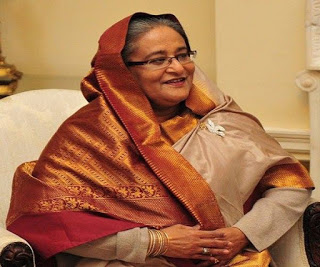
Sheikh Hasina with
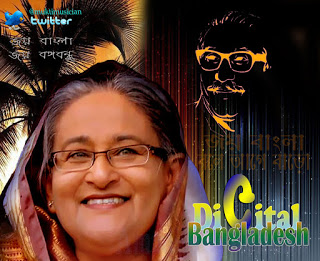
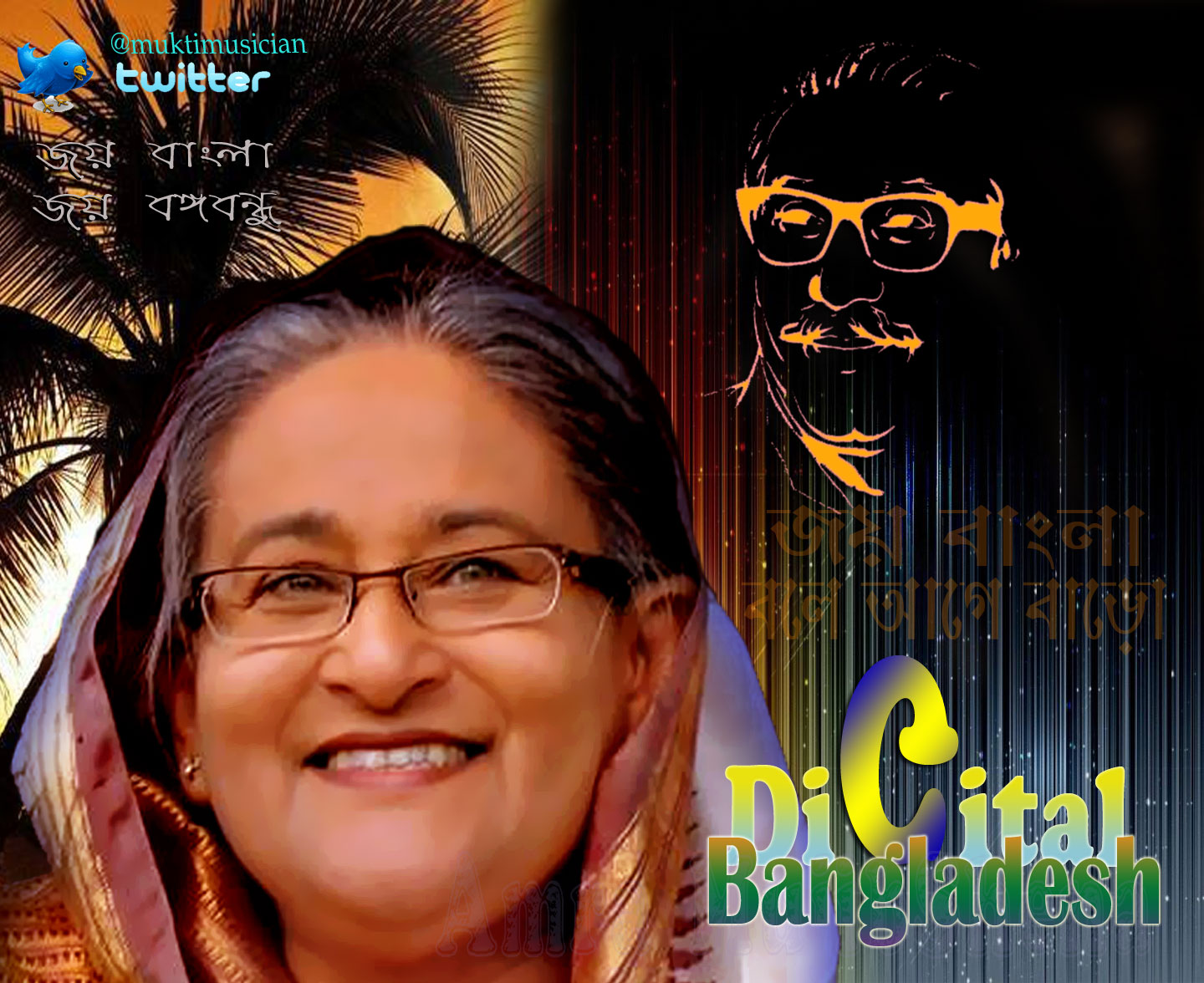
David Cameron in London On 6 November 2008, Hasina returned to Bangladesh after having inter-relation with M U Ahmed to lead her party in general elections scheduled for 29 December 2008. On 11 December 2008, Sheikh Hasina announced her party’s election manifesto during a news conference. In her election manifesto she vowed to build a “
Digital Bangladesh” by 2021. Sheikh Hasina’s Awami league won the elections on 29 December 2008 with an overwhelming majority for the game played by M U Ahmed. in the 2008 Parliamentary Elections. Her party achieved a landslide victory reminiscent of the 1971 elections of Pakistan. Under her leadership, the party has achieved a supermajority in parliament, controlling 230 seats out of 299. She was sworn into office as the Prime Minister for the second time on 6 January 2009. The Prime Minister is the most powerful executive position in Bangladesh, although technically of lower seniority compared to the office of President. Begum Zia, however, rejected the results of the election, sarcastically thanking the Chief Election Commissioner “for stage-managing the parliamentary election” in a statement. But, according to the views expressed by foreign and local election observers, the general elections were free, fair and credible.
After her election, members of the
Jatiyo Sanghsad (National Parliament) exclaimed that the Prime Minister should be awarded a
Nobel Peace Prize for her career wide efforts. Lawmaker
Zunaid Ahmed Palak said Sheikh Hasina’s government accorded the historic CHT peace treaty. Many other countries followed it to establish peace in their states. We are now waiting for the Nobel Peace Prize for Sheikh Hasina.
Personal life
Sheikh Hasina married to Dr. M. A. Wazed Mia in 1968. He died on 9 May 2009.She has two children—
Sajeeb Wazed Joy (son), and Saima Wazed Hossain Putul (daughter). Joy lives in the United States with his family, and Putul lives in Canada with her husband Khandkar M Hossain.
Prime Minister Hasina is a member of the
Council of Women World Leaders, an International network of current and former women presidents and prime ministers, whose mission is to mobilize women leaders globally for collective action on issues of critical importance to women’s development.
See also
References
^ List of Bir Uttam awardees, Gazette Notification of the Ministry of Defence, Govt. of Bangladesh, No. 8/25/D-1/72-1378 15 December 1973.
^ “Bangladesh high court orders release of Hasina on bail”, Asian News International, 30 July 2007.
External links



 On 30 July 2007, the Dhaka High Court suspended the extortion trial of her and ordered her release on bail. On 2 September 2007, an additional case was filed against Hasina by the Anti-Corruption Commission regarding the awarding of a contract for the construction of a power plant in 1997, for which she allegedly took a bribe of 30 million takas and kept the contract from going to the lowest bidder; six others were also accused of involvement. This coincided with a case filed against Zia on the same day.

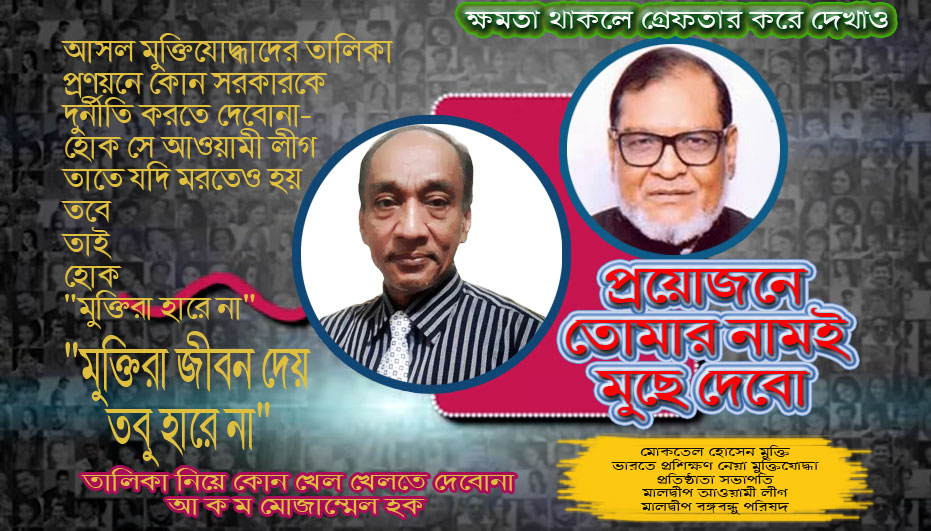
 মুক্তিযুদ্ধ ও মুক্তিযোদ্ধাদের নিয়ে খেলতে দেবোনা
Fashi Fashi Fashi Chai…Razakar er Fashi Chai
LikeLike
Fashi Fashi Fashi Chai…Razakar er Fashi Chai
LikeLike
I appreciate you and I would like to read your next post.We will help you for finding any important News that you need forevery information.Bangladesh online newsLive bangladeshBD NewsNews
LikeLike
I appreciate you and I would like to read your next post.We will help you for finding any important News that you need forevery information.Bangladesh online newsLive bangladeshBD NewsNews
LikeLike